Passover is English for the Jewish term Pesach, it is one of the most commonly observed Jewish holidays, even by otherwise non-observant Jews. It is an eight day festival that is celebrated in early spring, through the 15th to the 22nd of Nisan, the first of the ecclesiastical year & the 7th month (8th in a Jewish leap year).
Pesach is the first of three major pilgrimage festivals with both historical and agricultural significance. Agriculturally, it represents the beginning of harvest season in Israel, but this aspect is paid little attention. The primary observances of Pesach are told in the Exodus from Egypt after generations of slavery. It is also when the entire Jewish populace historically made a pilgrimage to the Temple of Jerusalem.
The story of Passover is old and familiar for this was the time that after decades of enslavement by the pharaohs of Egypt, in which the Israelites were subjected to backbreaking labor and other unbearable horrors. For when G_d saw the distress of His people He sent Moses, along with Aaron, Moses' older brother, to the Pharaoh to allow the Israelites to have a three-day leave so that G_d's people may celebrate a feast in the wilderness. Aaron and Moses go to the pharaoh many times with this commandment from G_d and each time the pharaoh refuses. Even when Aaron's staff is turned into a snake and eats the Pharaoh's sorcerers magic sticks, the pharaoh refuses.
After these refusals, Moses warns the pharaoh that if he does not comply with the three-day leave, G_d will smite Egypt. The pharaoh remained closed to the idea, so G_d sends a series of plagues upon Egypt, a devastating ten in total.In the attack of each plague, the pharaoh promises to let the Israelites go but always reneges on the promise the moment each affliction is removed.
 |
| Ten Plagues of Egypt |
The first of these plagues is water turning into blood. This is done when Aaron, upon G_d's instruction, strikes the Nile with his rod and turns the water into blood. As a result, the fish in the Nile River died and other bodies of water used by the Egyptians turned to blood as well. Plus there was a terrible stench accompanying this plague. But the Pharaoh's court magicians were able to do the same thing, so this is when the Pharaoh took back his word.
The second plague is the invasion of frogs. G_d commanded Moses to tell Aaron to stretch his staff over the water and a multitude of frogs came out of the Nile and overran Egypt. Again, the court magician was able to do the same thing, but he could not remove them and the Pharaoh was forced to allow the Israelites to leave and worship G_d, so that Moses would agree to remove the frogs. To prove that the frogs were divine punishment Moses let the Pharaoh choose the time that it would end. The Pharaoh chose the next day and the frogs died the following day. Again the Pharaoh took his word back.
The plague of lice is the third event. The Hebrew noun could be translated for lice, gnats or fleas. G_d gives instructions to Moses for Aaron to take his staff and strike the dust, which turned into a mass of lice that the Egyptians couldn't get rid of. The Egyptian sorcerers were unable to duplicate this and therefore declared it to be the "finger of G_d".
The fourth plague is hordes of wild animals or flies invade the cities. The Torah emphasizes that the arov ( mixture or swarm) only came against the Egyptians and that it did not affect the Land of Goshen, where the Israelites lived. Once again the Pharaoh asks Moses to remove this plague and promised to allow the Israelites freedom. Once again the plague was gone and so was the Pharaoh's word.
The fifth plague is the pestilence that kill only the Egyptian livestock; horses, camel, sheep,cows, donkeys, cattle and goats. The Israelite livestock is spared. Again the Pharaoh says no.
A plague of Shkhin, a kind of skin disease, that usually translates to "boils" is the sixth plague. G_d commanded Moses and Aaron to each take two handfuls of soot from the furnace, which Moses scattered skyward in front of the Pharaoh. The soot induced festering Shkhin eruptions on Egyptian men and their livestock. The Egyptian magicians were afflicted as well and was unable to heal themselves, much less Egypt.
Now the seventh plague of hail has come to Egypt. When G_d commanded Moses to stretch his staff skyward, at which time the storm started. This was evidently more supernatural than the former plagues, for the hail was intermixed with fire. The storm heavily damaged the Egyptian crops and orchards, as well as people and live stock. The Land of Goshen was spared. The Pharaoh once again asked Moses to remove the plague and promised to allow the Israelites to worship G_d in the wilderness. The storm stopped as Moses prayed and the Pharaoh says I changed my mind... no they can not go.
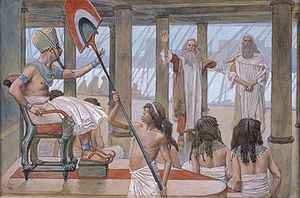 |
| Moses Speaks to Pharaoh (watercolor circa 1896-1902, James Tissot) |
Now by this time the Egyptian people have suffered much and they begged the Pharaoh to let the Israelites go. When Moses comes with the warning of the eighth plague, Pharaoh says: You say that you want to serve your G_d? I'll let the men go, as long as the women and children stay behind. No, says Moses, we must all go, men, women, children, cattle and herds. Pharaoh once again refuses.
The eighth plague that Moses warned of is the plague of locusts. It began on day 1 of the Hebrew month of Shevat. But before the plague came to be G_d told Moses that from that point on He would " harden the Pharaoh's heart" so that the Pharaoh would not give in and the remaining miracles (the final plagues and the parting of the Red Sea) would happen.
G_d has Moses stretch out his staff over Egypt and the wind picked up from the east. The wind continued until the next day, when it brought a swarm of locusts. The swarm was so thick that it cast a shadow over Egypt. What was left of Egyptian crops were consumed by the locusts, leaving no plant or tree standing. Again Moses was asked to remove the locusts with the promise of religious worship for the Israelites and this time G_d blew them into the Red Sea. And as promised by G_d the Pharaoh's harden heart said no.
In the ninth plague is darkness. G_d commanded Moses to stretch his hands toward the sky to bring darkness upon Egypt. It was so heavy that the Egyptians could feel it. This lasted for three days, during which time there was light in the homes of the Israelites. Moses is called by the Pharaoh and offered to let the Israelites leave, if only the darkness is removed from the land. However, he requires that the sheep and cattle stay. Moses refused, and went on to say that the Pharaoh would soon be offering to provide animals for sacrifice. This enraged the Pharaoh, who then threatened to execute Moses if he should again appear before the Pharaoh again. Moses replied that he would not.
This plague was an attack on the Egyptian sun god Ra. By introducing the plague of darkness, Moses attempted to demonstrate the clear power of G_d and the folly of worshiping Egyptian gods.
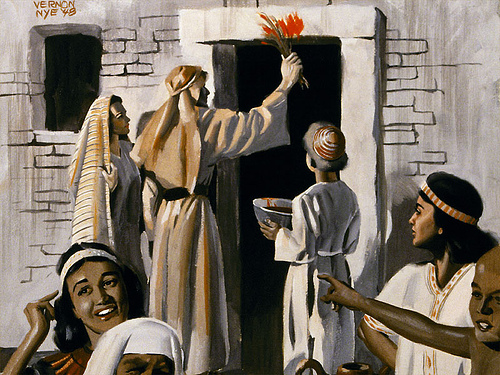
Before the final plague, the death of the firstborn, G_d has Moses tell the Israelites to mark lamb's blood on the doorposts of every door in which case the Lord will pass over them and they will not "suffer the destroyer to come into your house and smite you", thus sparing all the firstborns of the Israelites. This happened a the stroke of midnight of the 15th of the month of Nisan. This was the hardest blow to Egypt and the plague that not only took the Pharaoh's firstborn but it finally convinced to let the Israelites go.
As Moses quickly leads the Israelites out of Egypt, the Pharaoh changes his mind and send soldiers to retrieve his former slaves As the Egyptian army approaches the fleeing Israelites at the edge of the Red Se the final miracle happens: G_d parts the Red Sea, allowing Moses and his followers to cross safely, then closes the passage and drowns the Egyptians. According to the Jewish Bible, the Israelites- now numbering in the hundreds of thousands- then traveled through the Sinai desert for 40 tumultuous years before reaching their ancestral home of Canaan, later known as the Land of Israel.

The day before Passover is known as the Fast of the Firstborn, a minor fast commemorating the fact that the firstborn sons of Jewish households were not killed in Egypt during the final plague.
On the first night of Pesach there is a special family meal filled with a ritual to remind Jews of the significance of the holiday. This is what is called a seder, from the Hebrew root word for "order", because there is a specific set of information that must be discussed in a specific order. It is the same root from which the word "siddur" (prayer book) is derived.
Passover (Pesach) is divided into two parts:
The first two days and the last two days (the latter commemorating the parting of the Red Sea) are full fledged holidays. Holiday candles are lit at night and kiddush* and wonderful holiday meals are enjoyed on both nights and days. However, Jews don't go to work, drive, turn on or off electrical appliances ( some appliances now come with a Shabbat mode*) and write. But cooking and to carry outdoors*.

The middle four days are called chol hamoed, semi-festive "intermediate days", when most forms of work is allowed.
 |
| Chametz |
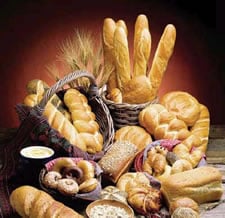
What is probably the most significant part of Passover is the avoidance of chametz, leaven bread. This commemorates the unleavened bread that the Israelis ate when they left Egypt, because there was no time for their bread to rise. Jews don't keep any kind of chametz from midday the day before Passover to the end of the holiday. This also includes not having any kind of food or drink that contains leavened grain such as, cakes, breads, cookies, cereal, pasta, and most alcoholic drinks, beer, Scotch, etc. And almost all process food can be considered chametz, unless otherwise stated.
Ridding the home of chametz is an intensive process. It involves a full on spring-cleaning mission weeks before the holiday and climaxes with the search for chametz on the night before Passover and the burning of the chametz ceremony the morning before the holiday. Chametz that cannot be disposed of can be sold to a non-Jew for the duration of Passover.
 | |
| Matzah and Kiddush Cup |
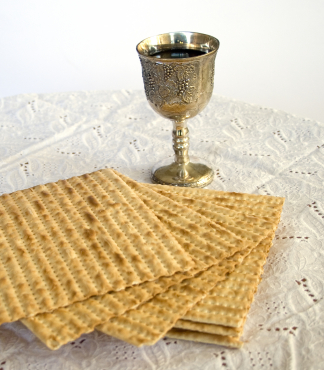
Instead of eating chametz, Jews eat matzah, a flat unleavened bread. It is a mitzvah* to partake in matzah on the two Seder nights and during the rest of the holiday it is optional.

The highlight of Pesach is the Seder, which is observed on the first two nights of the holiday. The Seder is a 15 step family-oriented tradition and ritual packed meal. They are:
- Kaddesh : Sanctification - A blessing over wine in honor of the holiday. The wine is drunk and the second cup is poured.
- Urechatz : Washing - A washing of the hands without a blessing in preparation for eating karpas.
- Karpas : Vegetable - Parsley dippedJewish people. The salt water represents the tears that they shed in slavery.
- Yachatz : Breaking - One of the three matzahs on the table is broken. Part is returned to the pile the other is set aside for afikomen.
- Maggid : The story - The retelling of the Exodus out of Egypt and the first Passover. This begins with the youngest child present asking the Four Questions also known as Mah Nishtanah ( Why is it different?)*, but if there are no children at the Seder then anyone can ask. The maggid is designed to satisfy the needs of four different types of people : the wise one, who wants to know the technical details; the wicked one, who excludes himself (and learns the penalty for doing this); the simple one, who needs to know the basics; and the one who is unable to ask, for he doesn't even know enough to know what he needs to know. At the end of the maggid a blessing is said over the second cup of wine and it is drunk.
- Rachtzah : Washing - Second washing of the hand, but with a blessing, in prepparation of the eating of the matzah.
- Motzi : Blessing over grain products - The ha-motzi blessing is a generic blessing for bread or grain products used as a meal, is recited over the matzah.
- Matzah : Blessing over Matzah - A specific matzah blessing is recited and a bit of matzah is eaten.
- Maror : Bitter Herbs - Blessing recited over a bitter vegetable, usually raw horseradish and it 's eaten. This symbolizes the bitterness of slavery.The maror is dipped in charoset, a mixture of apples, nuts, cinnamon and wine, which is symbolic of the mortar used by the Jews during slavery.
- Korekh : The Sandwich - Rabbi Hillel* was of the opinion that the maror should be eaten together between two pieces of matzah . In his honor, some maror is put on a small piece of matzah, with some charoset, and eaten.
- Shulchan Orekh : Dinner- The festive meal is eaten.Traditionally this begins with the charred egg on the Seder plate. Otherwise, with the exception of chamez,there is no particular requirement regarding what to eat at this meal. Some Jewish Families serve matzah ball soup, while others may serve turkey or beef brisket.
- Tzafun : The Afikomen - This is the piece of matzah that was set aside earlier and is now eaten as 'dessert', the last food of the meal. Different families have different customs when it comes to the afikomen. In some families the parents hide the piece of matzah and the children go in search of it and in other families, the children hide it and the parents go and look for the matzah. But mainly it is the children who do the searching because the adults want them to stay awake and attentive throughout the pre-meal proceedings, waiting for this part.
- Barekh - Grace After Meals - The third cup of wine is poured and the birkat ha-mazon (grace after meals) is recited. This is similar to the grace that would be said on any Shabbat. At the end, a blessing is said over the third cup of wine and it's drunk. The fourth cup is poured, including a cup set aside for the prophet Elijah, who is supposed to have herald the Messiah and is supposed to come on Pesach to do this. The door is opened for a while at this point for Elijah.
- Hallel : Praises - Several psalms are recited. And a last blessing is recited over the cup of the last wine and it is drunk.
- Nirtzah : Closing - A simple statement that the Seder has been completed, with a wish that next year, that the Jews may celebrate Pesach in Jerusalem. This is followed by various hymns and stories.
* kiddush - A blessing recited over a cup of wine
* Shabbat (Sabbath) mode - a feature in many modern home appliances, including refrigerators and ovens, which is intended to allow the appliance to be used ( subject to various constraints) by Shabbat-observant Jews on the Shabbat or and Jewish holidays. Observant Jews interpret the Jewish law forbidding them from doing creative work on the Shabbot, to include making a fire, preparing meals or even closing a switch or pressing a button.
* Carry outdoors : http://www.chabad.org/holidays/passover/pesach_cdo/aid/708532/jewish/Laws-of-Yom-Tov.htm
*Mitzvah - Refers to precepts and commandments as commanded by G_d. Any of the 613 commandments that Jews are obligated to observe. It can also refer to any Jewish religious obligation or more generally, any good deed.
* The Four Questions (Mah Nishtanah) :
1. Why is it on all other nights during the year we eat either leavened bread or matzah, but on this night we eat only matzah? We eat only matzah because our ancestors could not wait for their breads to rise when they were fleeing slavery in Egypt and so they were flat when they came out of the oven.
2. Why is it that on all other nights we eat all kinds of vegetable, but on this night we eat bitter herbs? We eat only Maror, a bitter herb, to remind us of the bitterness of slavery that our ancestors while in Egypt.
3. Why is it that on all other nights we do not dip [our food] even once, but on this night we dip them twice? The first dip, green vegetable in salt water, symbolizes the replacing of our tears with gratefulness and the second dip, maror in charoset, symbolizing the sweetening of our burden of bitterness and suffering.
4. Why is it that on all other nights we dine either sitting upright or reclining, but on this night we all recline? We recline at the Seder table because in ancient times, a person who reclined at a meal was a free person, while slaves and servants stood.
* Rabbi Hillel - A famous Jewish religious leader leader born around 110 B.C.E.in Babylon and died 10 CE. in Jerusalem. He is responsible for the Golden Rule. For more information about Hillel the Elder : http://www.jewishencyclopedia.com/articles/7698-hillel