|
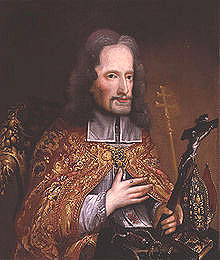
| St. Oliver Plunkett |
St. Oliver Plunkett Roman Catholic Archbishop of Armagh and Primate of All Ireland. He was born November 1,1625 in Longcrew, County Meath, Ireland to well-to-do parents of Hibenro-Norman
* ancestry. Until he was sixteen his St. Oliver Plunkett's education was entrusted to his cousin Patrick Plunkett, Abbot of St. Mary's, Dublin and his brother the first Earl of Fingall, who would go on to become a bishop, sequentially, of Meath and Ardagh . Hopeful to become a priest himself, St. Oliver Plunkett set out for Rome in 1647 under the care of Father Pierfrancesco Scarampi of the Roman Oratory. While at this time in Ireland the Irish Confederate Wars
* was taking place. Scarampi was the Papal Envoy to the Roman Catholic movement known as the Confederation of Ireland
*. Many of St. Oliver Plunkett's relatives were involved in the movement.
St. Oliver Plunkett was admitted to the Irish College in Rome and proved to be an able student. In 1654 he was ordained a priest and was chosen by the Irish bishops to be their representative in Rome. Meanwhile, Oliver Cromwell had conquered Ireland in what is known as the Cromwellian conquest of Ireland or Cromwellian Wars(1649-53) by defeating the Roman Catholic cause in Ireland. And as a result Roman Catholicism was banned in Ireland and the Roman Catholic clergy were executed. As a result the return to Ireland for St. Oliver Plunkett was impossible for many years. He was able to remain in Rome as a professor of theology due to his petitioning the right people. Throughout the period of the Commonwealth and the first years of Charles II reign he was able to successfully plead the cause of the Irish Roman Church and also served as theological professor at the College of Propaganda Fide
* . At the Congregation of Propaganda Fide on July 9,1669, he was appointed Archbishop of Armagh, the Irish primatial see and was consecrated on November 30 at Ghent by the Bishop of Ghent. On March 7,1670 St. Oliver Plunkett was on Irish soil once more, as the English Restoration of 1660 started on a tolerant basis. The pallium
* was granted to him in a formal meeting of the Sacred College of Cardinals of July 28,1670.
After returning back to Ireland, Saint Oliver Plunkett set about restoring the devastated Roman Catholic church and the rebuilding of schools for both the young and the clergy, whom he found to be 'ignorant moral theology and controversies'. He also tackled the drunkenness of the clergy, writing ' Let us remove this defect from an Irish priest and he will be a saint'. The Penal Laws
* had been relaxed in line with the Declaration of Breda
* in 1660 and he was able to set up a Jesuit college in Drogheda in 1670. In 1671 the collage had 150 students, with no fewer than 40 who were Protestants, making this the first integrated school in Ireland.
The persecution of Saint Oliver Plunkett began when he would not agree to, for doctrinal reason, the Test Act
* of 1673. As a result, the college was destroyed.Saint Oliver Plunkett then went into hiding, traveled in disguise and refused British government edict to register at a seaport to await exile. In 1678, Englishman Titus Oates concocted a fictional story called the Popish Plot
*, which led to even further anti-Catholic sentiments. Archbishop Peter Talbot of Dublin was arrested and Saint Oliver Plunkett again went into hiding. The Privy Council in London was told that he had plotted an invasion by French forces.
Despite being on the run and having a price on his head, he refused to leave his flock. As a result, in December of 1679, he was arrested and sent to Dublin Castle, where he gave absolution to the dying Archbishop Talbot. At some point, before his final incarceration, Saint Oliver Plunkett took refuge in a church in Killartry in County Loudth, in the parish of Clogerhead, seven miles outside Drogheda. He was initially tried at the town of Dundalk for conspiring against the state by plotting to bring 20,000 French soldiers into the country and levying a tax on his clergy to support a 70,000 men for rebellion. Though this was proven to be false, there were some in government circles who worried about, and some used the excuse, that another rebellion was being plotted.
Lord Shaftesbury, a founder of the Whig Party, knew that Saint Oliver Plunkett was not going to be found guilty in Ireland and had him moved to Newgate Prison, London. The first grand jury did not indict him, but he was not released. The second trial was claimed to be a kangaroo court; it was written that the judge, Sir Francis Pemperton, claimed that the trial was a disgrace to himself and his country. In June of 1861,Saint Oliver Plunkett was found guilty of high treason and was condemned to death.

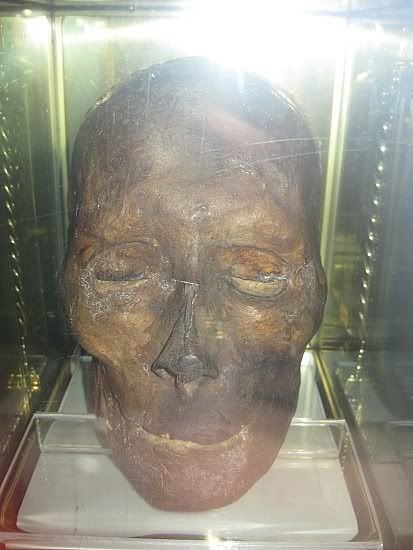
On July 1, 1681, Saint Oliver Plunkett was hanged, drawn and quartered at the village of Tyburn. He became the last Roman Catholic martyr to die in England. Initially, he was buried in two tin boxes next to five Jesuits who had died in the courtyard of St. Giles. His body was later exhumed in 1683 and moved to the Benedictine monastery in at Lamspringe, near Hildesheim, Germany. The head was brought to Rome and from there to Armagh and eventually Dogheda when, since June 29,1921, it has rested in St. Peter's Church. Most of the body was bought to Downside Abbey
*, England, where the major part is located today, with some parts remaining in Lamspringe. Some relics were brought to Ireland in May of 1975, while others were taken to America ,France, Germany, Australia and England.
When Saint Oliver Plunkett was beatified in 1920 and canonised in 1975, he became the first Irish saint in almost 700 years and the first of the Irish martyrs to be beatified. For his canonisation the customary second miracle was waived.
During Saint Oliver Plunkett's time his ministry was the most successful and he confirmed over 48,000 people in four years.
In 1997, he became the patron saint for peace and reconciliation in Ireland, adopted by the prayer group campaigning for peace in Ireland, ' St. Oliver Plunkett for Peace and Reconciliation '.
 |
| The head of Saint Oliver Plunkett |
* Hiberno-Norman : Norman lords who settled in Ireland who admitted little if any real allegiance to the Aglo-Normansettlers in England and who began to interact and marry with the Gaelic nobility of Ireland.
* Confederate Wars : Irish Confederate Wars, aka the Eleven Years War, took place in Ireland between 1641 and 1653. It pitted native Irish Catholics against English and Scottish Protestant colonists and their supporters. It was both ethnic and religious conflict - fought over which would govern Ireland, whether it would be governed from England and which religious group would dominate Ireland.
* Confederate Ireland : Period of Irish self-government between the Rebellion of 1621 and the Cromwellian conquest of Ireland in 1649. This period was also known as " the Confederation of Kilkenny".
* College of Propaganda Fide : Is the other name of Pontifical Urbaniana University or Pontifical Urban University. It is a type of Catholic university established by and is directly under the authority of the Holy See in Rome. It is also known as The Collegio Urbano of Propaganda Fide.
* pallium : A circular white wool band with pendants worn over the shoulders by the pope or archbishop.
* the Penal Laws : In Ireland this was a series of laws imposed in an attempt to force Irish Roman Catholics and Protestant dissenters ( such as Presbyterians ) to accept the reformed Christian faith as defined by the English state established Anglican Church and practised by members of the Irish state established Church of Ireland.
* Declaration of Breda : A proclamation, issued on April 4,1660, by Charles II of England in which he promised a general pardon for crimes committed during the English Civil War and the Interregnum for all those who recognised Charles as the lawful king; the retention by the current owners of property purchased during this same period; religious toleration and the payments of money that is overdue to the army and the army would be recommissioned into the service under the crown. The first three pledges were subject to amendment by acts of Parliament.
* Test Act : A series of English penal laws that served as a religious test for public office and imposed various civil disabilities on Catholics and Nonconformists.
* Popish Plot : A fictitious story made-up by Titus Oates that gripped England, Wales and Scotland into an anti-Catholic hysteria between 1678 - 1681.
* Downside Abbey : The common name for The Basilica of St. Gregory the Great at Downside. It is a Catholic Benedictine monastery and the Senior House of the English Benedictine Congregation.