Welcome

Showing posts with label Religious. Show all posts

Wednesday, March 19, 2014

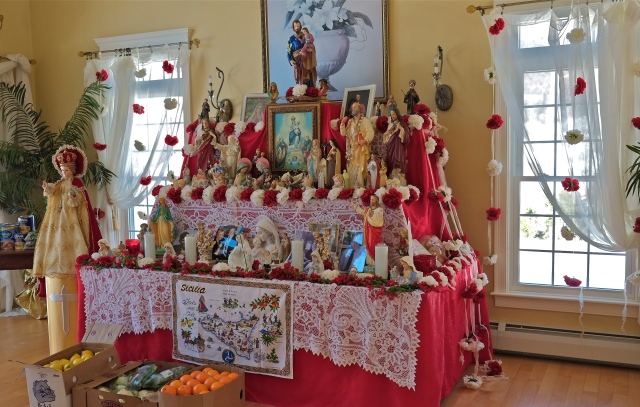
St. Joseph's Day 2014


  March 19 is St. Joseph Feast Day and traditionally falls during the Lenten season and is a day of abstinence, which is why St. Joseph tables and alters are meatless.

  If the feast falls on a Sunday other than Palm Sunday. it is observed on the next available day, usually Monday, March 20, unless it is another saints feast day. Since 2008, if St. Joseph's Day falls during Holy Week, it is moved to the closest date possible before March 19, usually the Saturday before Holy Week. This change was announced by  the Congregation for Divine Worship in March-April 2006.

  St. Joseph is the patron saint of the Catholic Church, carpenters, workers, unborn children, realtors, against doubt and hesitation, and a happy death. Personally, I think he should also be the patron saint of step-parents, foster parents and adoptive parents, for he was one and took in another's Child to raise as his own.

  St. Joseph is also the patron saint of many countries, such as: Croatia, Vietnam, Malta, Philippines, United States, Spain, and Italy are just some.

  On the Italian island of Sicily, where St. Joseph is regarded as the island's patron saint, and in many Italian-American communities, thanks are given to St. Joseph for helping to prevent a famine on the island during the Middle Ages. The drought was so severe in Sicily that the inhabitants prayed to their patron saint for rain and if St. Joseph answered their prayers the would prepare a large feast in his honor. As it is said, the rains came and the Sicilians prepared a large banquet for St. Joseph. The fava bean is the crop that saved the people of Sicily from starvation and is a traditional part of St. Joseph's Day altars. Giving food to the poor is a traditional part of St. Joseph's Day. In some communities. on St. Joseph's Day, it also traditional to wear red and eat the Neapolitan pastry, Zeppole.


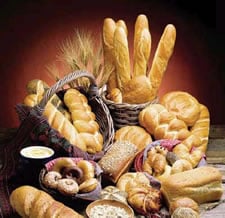
 On a typical St. Joseph altar people place, wine, limes, fava beans, candles, flowers, specially prepared cakes, breads and cookies (as well as other meatless dishes and zeppole. Foods are traditionally served containing bread crumbs for bread crumbs are the representation of sawdust since St. Joseph was a carpenter. Because the feast occurs during Lent there is no meat served on the celebration table. The altar has traditionally three tiers that represent the Trinity.


  In Italy St. Joseph's Day is also Father's Day. Good day to have I think.

 In the U.s. In Louisiana, especially New Orleans, which was a major port of entry for Sicilian immigrants in the late 19th century, St. Joseph's Day is a city-wide event and not just for those of Sicilian background. There are both public and private St. Joseph altars. For those that wish to pay homage the altars are usually open to visitors. After the altar is taken down the food is usually given to local charities.

  There are also parades held to honor St. Joseph and the Sicilian population in New Orleans, which is akin to those of St. Patrick's Day and Mardi Gras. On this day, some Mardi Gras Indians stage their last procession of the season on the Sunday nearest to St. Joseph's Day. This is known as "Super Sunday" and afterwards their costumes are dismantled.

New Orleans St. Joseph's Day 2014 courtesy of The Times-Picayune


Monday, December 24, 2012

Merry Christmas

I  would just like to say that I appreciate everyone who has stopped by and read my blog, it is gratefully appreciated. So, here is wishing you and yours a Peaceful and a Happy Christmas.


Nativity by Italian Renaissance artist, Pietro Perugino, ca. 1504


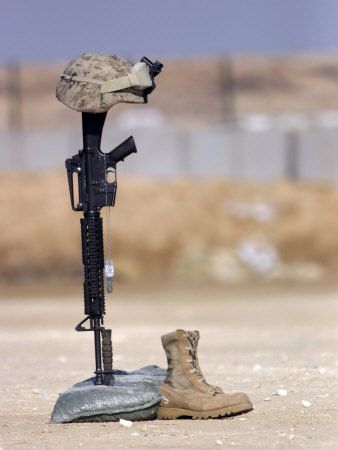
A Soldier's Christmas Night Before Christmas by Lance Corporal James M. Schmidt

Let us not forget those that will not be able to be here with us because of wars.


This is from the Disabled American Veterans. There is no title but I call it  'A Soldier's Night Before Christmas' and it was written by Lance Corporal James M. Schmidt.

Twas the night before Christmas, he lived all alone,
in a one bedroom house made of plaster and stone.
I had come down the chimney with presents to give,
and to see just who in this house did live.
I looked all about, a strange sight I did see,
no tinsel, no presents, not even a tree.

No stocking by mantle,just boots filled with sand,
and on the wall pictures of far distant lands.
With medals and badges, awards of all kinds.a sobering thought came to mind.
For this house was different, so dark and so dreary,
the home of a soldier, now I see clearly.

The soldier lay sleeping, silent, alone,
curled up on the floor in this one bedroom home.
The face was so gentle, the room in such disorder,
not how I pictured a United States soldier.
Was this the hero of whom I just read?
Curled up on a poncho, the floor for a bed?

I realized the families that I saw that night,
owed their lives to these soldiers who are willing to fight.
Soon round the world, the children would play,
and grownups would celebrate a bright Christmas day.
They all enjoyed their freedom each month of the year,
because of the soldiers, like the one lying here.

I couldn't help but wonder how many lay alone,
on a cold Christmas eve in a land far from home.
The very thought brought a tear to my eye,
I dropped to my knees and started to cry.
The soldier awakened and I heard a rough voice,
"Santa don't cry, this life is my choice;

I fight for freedom, I don't ask for more.
my life is my God, my country, my corps." 
The soldier rolled over and soon drifted to sleep,
I couldn't control it, I started to weep.
I kept watch for hours, so silent and still,
and we both shivered from the cold evening's chill.

I didn't want to leave on that cold, dark, night,
this guardian of honor so willing to fight.
Then the soldier rolled over, with a voice soft and pure,
whispered, "Carry on Santa it's Christmas day, all is secure."
One look at my watch, and I knew he ws right.
"Merry Christmas my friends and to all a good night."


_______________________________________

I hope I'm not the only one crying my eyes out.

Thursday, July 19, 2012

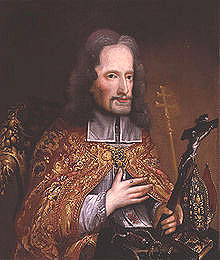
Saint Oliver Plunkett

St. Oliver Plunkett


  St. Oliver Plunkett Roman Catholic Archbishop of Armagh and Primate of All Ireland. He was born November 1,1625 in Longcrew, County Meath, Ireland to well-to-do parents of Hibenro-Norman* ancestry. Until he was sixteen his St. Oliver Plunkett's education was entrusted to his cousin Patrick Plunkett, Abbot of St. Mary's, Dublin and his brother the first Earl of Fingall, who would go on to become a bishop, sequentially, of Meath and Ardagh . Hopeful to become a priest himself, St. Oliver Plunkett set out for Rome in 1647 under the care of Father Pierfrancesco Scarampi of the Roman Oratory. While at this time in Ireland the Irish Confederate Wars* was taking place. Scarampi was the Papal Envoy to the Roman Catholic movement known as the Confederation of Ireland*. Many of St. Oliver Plunkett's relatives were involved in the movement.


  St. Oliver Plunkett was admitted to the Irish College in Rome and proved to be an able student. In 1654 he was ordained a priest and was chosen by the Irish bishops to be their representative in Rome. Meanwhile, Oliver Cromwell had conquered Ireland in what is known as the Cromwellian conquest of Ireland or Cromwellian Wars(1649-53) by defeating the Roman Catholic cause in Ireland. And as a result Roman Catholicism was banned in Ireland and the Roman Catholic clergy were executed. As a result the return to Ireland for St. Oliver Plunkett was impossible for many years. He was able to remain in Rome as a professor of theology due to his petitioning the right people. Throughout the period of the Commonwealth and the first years of Charles II reign he was able to successfully plead the cause of the Irish Roman Church and also served as theological professor at the College of Propaganda Fide* . At the Congregation of Propaganda Fide on July 9,1669, he was appointed Archbishop of Armagh, the Irish primatial see and was consecrated on November 30 at Ghent by the Bishop of Ghent. On March 7,1670 St. Oliver Plunkett was on Irish soil once more, as the English Restoration of 1660 started on a tolerant basis. The pallium* was granted to him in a formal meeting of the Sacred College of Cardinals of July 28,1670.

  After returning back to Ireland, Saint Oliver Plunkett set about restoring the devastated Roman Catholic church and the rebuilding of schools for both the young and the clergy, whom he found to be 'ignorant moral theology and controversies'. He also tackled the drunkenness of the clergy, writing ' Let us remove this defect from an Irish priest and he will be a saint'. The Penal Laws* had been relaxed in line with the Declaration of Breda* in 1660 and he was able to set up a Jesuit college in Drogheda in 1670. In 1671 the collage had 150 students, with no fewer than 40 who were Protestants, making this the first integrated school in Ireland.


 The persecution of Saint Oliver Plunkett began when he would not agree to, for doctrinal reason, the Test Act* of 1673. As a result, the college was destroyed.Saint Oliver Plunkett then went into hiding, traveled in disguise and refused British government edict to register at a seaport to await exile. In 1678, Englishman Titus Oates concocted a fictional story called the Popish Plot*, which led to even further anti-Catholic sentiments. Archbishop Peter Talbot of Dublin was arrested and Saint Oliver Plunkett again went into hiding. The Privy Council in London was told that he had plotted an invasion by French forces.

  Despite being on the run and having a price on his head,  he refused to leave his flock. As a result, in December of 1679, he was arrested and sent to Dublin Castle, where he gave absolution to the dying  Archbishop Talbot. At some point, before his final incarceration, Saint Oliver Plunkett took refuge in a church in Killartry in County Loudth, in the parish of Clogerhead, seven miles outside Drogheda.  He was initially tried at the town of Dundalk  for conspiring against the state by plotting to bring 20,000 French soldiers into the country and levying a tax on his clergy to support a 70,000 men for rebellion. Though this was proven to be false, there were some in government circles who worried about, and some used the excuse, that another rebellion was being plotted.

  Lord Shaftesbury, a founder of the Whig Party,  knew that Saint Oliver Plunkett was not going to be found guilty in Ireland and had him moved to Newgate Prison, London. The first grand jury did not indict him, but he was not released. The second trial was claimed to be a kangaroo court; it was written that the judge, Sir Francis Pemperton, claimed that the trial was a disgrace to himself and his country. In June of 1861,Saint Oliver Plunkett was found guilty of high treason and was condemned to death.


On July 1, 1681, Saint Oliver Plunkett was hanged, drawn and quartered  at the village of Tyburn. He became the last Roman Catholic martyr to die in England. Initially, he was buried in two tin boxes next to five Jesuits who had died in the courtyard of St. Giles. His body was later exhumed in 1683 and moved to the Benedictine monastery in at Lamspringe, near Hildesheim, Germany. The head was brought to Rome and from there to Armagh and eventually Dogheda when, since June 29,1921, it has rested in St. Peter's Church. Most of the body was bought to Downside Abbey*, England, where the major part is located today, with some parts remaining in Lamspringe. Some relics were brought to Ireland in May of 1975, while others were taken to America ,France, Germany, Australia and England.

  When  Saint Oliver Plunkett was beatified in 1920 and canonised in 1975, he became the first Irish saint in almost 700 years and the first of the Irish martyrs to be beatified. For his canonisation the customary second miracle was waived.

  During Saint Oliver Plunkett's  time his ministry was the most successful and he confirmed over 48,000 people in four years.

  In 1997, he became the patron saint for peace and reconciliation in Ireland, adopted by the prayer group campaigning for peace in Ireland, ' St. Oliver Plunkett for Peace and Reconciliation '.

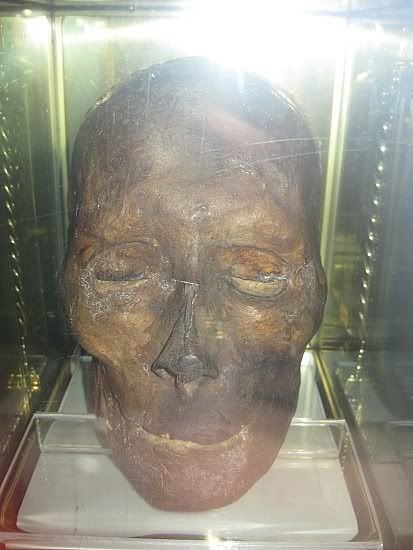
The head of Saint Oliver Plunkett


 *  Hiberno-Norman : Norman lords who settled in Ireland who admitted little if any real allegiance to the Aglo-Normansettlers in England and who began to interact and marry with the Gaelic nobility of Ireland.

*  Confederate Wars : Irish Confederate Wars, aka the Eleven Years War, took place in Ireland between 1641 and 1653. It pitted native Irish Catholics against English and Scottish Protestant colonists and their supporters. It was both ethnic and religious conflict - fought over which would govern Ireland, whether it would be governed from England and which religious group would dominate Ireland.

*  Confederate Ireland : Period of Irish self-government between the Rebellion of 1621 and the Cromwellian conquest of Ireland in 1649. This period was also known as " the Confederation of Kilkenny".

*   College of Propaganda Fide : Is the other name of Pontifical Urbaniana University or Pontifical Urban University. It is a type of Catholic university established by and is directly under the authority of the Holy See in Rome. It is also known as The Collegio  Urbano of Propaganda Fide.

*  pallium : A circular white wool band with pendants worn over the shoulders by the pope or archbishop.

*  the Penal Laws : In Ireland this was a series of laws imposed in an attempt to force Irish Roman Catholics and Protestant dissenters ( such as Presbyterians ) to accept the reformed Christian faith as defined by the English state established Anglican Church and practised by members of the Irish state established Church of Ireland.

*  Declaration of Breda : A proclamation, issued on April 4,1660, by Charles II of England in which he promised a general pardon for crimes committed during the English Civil War and the Interregnum for all those who recognised Charles as the lawful king; the retention by the current owners of property purchased during this same period; religious toleration and the payments of money that is overdue to the army and the army would be recommissioned into the service under the crown. The first three pledges were subject to amendment by acts of Parliament.

*  Test Act : A series of English penal laws that served as a religious test for public office and imposed various civil disabilities on Catholics and Nonconformists.

*  Popish Plot :  A fictitious story made-up by Titus Oates that gripped England, Wales and Scotland into an anti-Catholic hysteria between 1678 - 1681.

*  Downside Abbey : The common name for The Basilica of St. Gregory the Great at Downside.  It is a Catholic Benedictine monastery and the Senior House of the English Benedictine Congregation. 


Saturday, April 7, 2012

Happy Easter - 2012


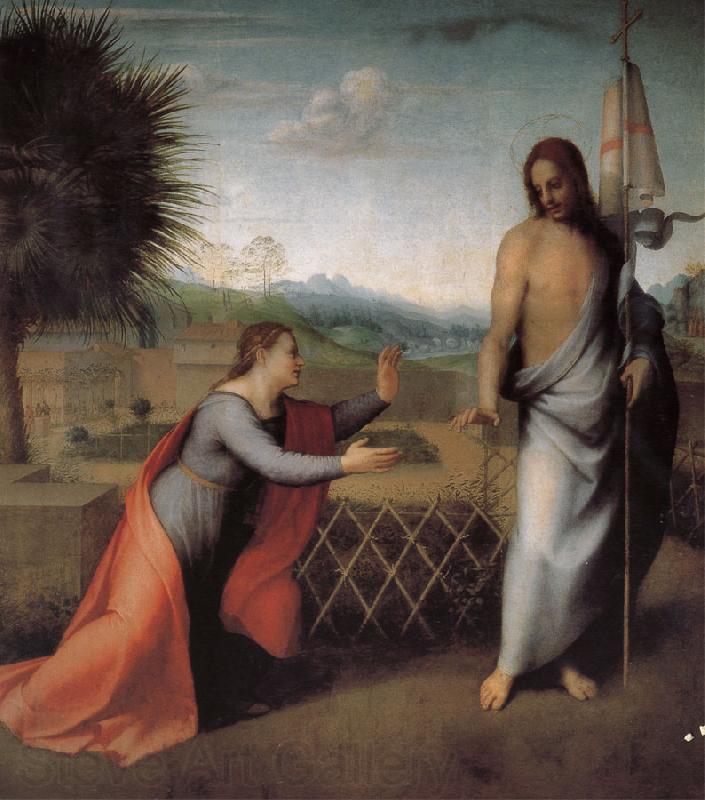
  Hoping for a Blessful Easter, for He rose on this day. Love Him, Respect Him, Honor Him.


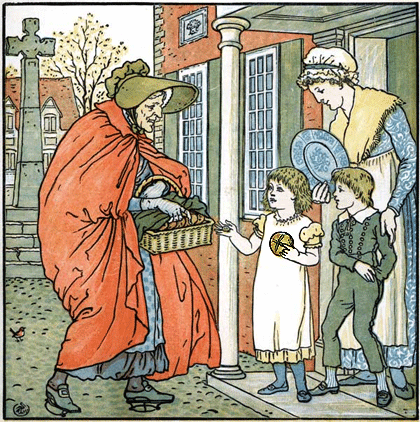
Hot Cross Buns


Hot cross buns!
Hot cross buns!
One ha' penny, two ha' penny,
Hot cross buns!
If you have no daughters,
Give them to your sons.
One ha' penny,
Two ha' penny, 
Hot cross buns!

  So goes the nursery rhyme with the earliest record of it in Christmas Box, published in London in 1798. However there is an even earlier reference to "Hot Cross Buns" as a street cry, for example in Poor Robin's Almanack for 1733, though many quibble over the date of their origin most agree that they predate 1733:

"Good Friday comes this month the old woman runs
With one or two penny hot cross buns" 

  Hot cross buns are popular in the days of Tudors, as there are specific mentions of them being allowed to be baked under certain conditions by Elizabeth I in 1592. This is because Protestant English monarch were saw the hot cross buns as a dangerous holdover of Catholic belief's in England being baked in the dough used in making communion wafers. However, maybe the most fascinating mention is in Sue Ellen Thompson's Holiday Symbols and Customs :

  "When archeologists excavated the ancient city of
Herculaneum in southwestern Italy, which had been buried 
volcanic ash and lava since 79 C.E., they found two small 
loaves, each with a cross on it, among the ruins.


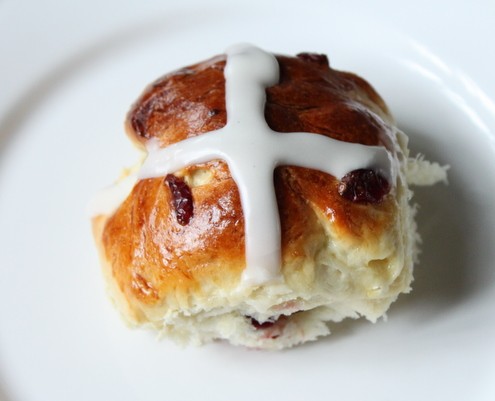
Hot cross bun is a sweet spiced bun made with raisins or currants and marked with a cross on top and is traditionally eaten on Good Friday.  

  In many historical Christian countries, buns are usually eaten hot or toasted on Good Friday, with the cross symbolizing the Crucifixion.

  It is believed that buns marked with a cross  were eaten by Saxons in honor of Eostre, Germanic goddess that is the namesake of Easter. The cross is thought to have symbolized the four quarters of the moon. Other claim that the Greeks marked cakes with a cross much earlier.

  In English folklore there are many superstitions regarding the hot cross bun. One of them is that buns baked and served on Good Friday will not spoil or become moldy during the subsequent year. Another one is to keep a hot cross bun for medicinal purposes. A piece of it is given to someone who is ill and  is said to help them recover.

  Sharing a hot cross bun with another is supposed to be ensure friendship throughout the coming year, particularly if "Half for you and half for me, Between us two shall goodwill be" is said at that time. Because of the cross on the buns, some say they should be kissed before eaten. If taken on a sea voyage, are said to protect against shipwrecks. If hung in the kitchen, they are said to protect against fires and ensure that all breads turn out perfect. Each year the hanging bun is replaced.


Friday, April 6, 2012

Pesach/Passover


Passover is English for the Jewish term Pesach, it is one of the most commonly observed Jewish holidays, even by otherwise non-observant Jews. It is an eight day festival that is celebrated in early spring, through the 15th to the 22nd of Nisan, the first of the ecclesiastical year & the 7th month (8th in a Jewish leap year).

   Pesach is the first of three major pilgrimage  festivals with both historical and agricultural significance. Agriculturally, it represents the beginning of harvest season in Israel, but this aspect is paid little attention. The primary observances of Pesach  are told in the Exodus from Egypt after generations of slavery. It is also when the entire Jewish populace historically made a pilgrimage to the Temple of Jerusalem.

  The story of Passover is old and familiar for this was the time that after decades of enslavement by the pharaohs of Egypt, in which the Israelites  were subjected to backbreaking labor and other unbearable horrors. For when G_d saw the distress of His people He sent Moses, along with Aaron, Moses' older brother, to the Pharaoh to allow the Israelites to have a three-day leave so that G_d's  people may celebrate a feast in the wilderness. Aaron and Moses go to the pharaoh many times with this commandment from G_d and each time the pharaoh refuses. Even when Aaron's staff is turned into a snake and eats the Pharaoh's sorcerers magic sticks, the pharaoh refuses.

  After these refusals, Moses warns the pharaoh that if he does not comply with the three-day leave, G_d will smite Egypt. The pharaoh remained closed to the idea, so G_d sends a series of plagues upon Egypt, a devastating ten in total.In the attack of each plague, the pharaoh promises to let the Israelites go but always reneges on the promise the moment each affliction is removed.

Ten Plagues of Egypt


  The first of these plagues is water turning into blood. This is done when Aaron, upon G_d's instruction, strikes the Nile with his rod and turns the water into blood. As a result, the fish in the Nile River died and other bodies of water used by the Egyptians turned to blood as well. Plus there was a terrible stench accompanying this plague. But the Pharaoh's court magicians were able to do the same thing, so this is when the Pharaoh took back his word.

  The second plague is the invasion of frogs. G_d commanded Moses to tell Aaron to stretch his staff over the water and a multitude of frogs came out of the Nile and overran Egypt. Again, the court magician was able to do the same thing, but he could not remove them and the Pharaoh was forced to allow the Israelites to leave and worship G_d, so that Moses would agree to remove the frogs. To prove that the frogs were divine punishment Moses let the Pharaoh choose the time that it would end. The Pharaoh chose the next day and the frogs died the following day.  Again the Pharaoh took his word back.

  The plague of lice is the third event.  The Hebrew noun could be translated for lice, gnats or fleas. G_d gives instructions to Moses for Aaron to take his staff and strike the dust, which turned into a mass of lice that the Egyptians couldn't get rid of. The Egyptian sorcerers were unable to duplicate this and therefore declared it to be the "finger of G_d".

  The fourth plague is hordes of wild animals or flies invade the cities. The Torah emphasizes that the arov ( mixture or swarm) only came against the Egyptians and that it did not affect the Land of Goshen, where the Israelites lived. Once again the Pharaoh asks Moses to remove this plague and promised to allow the Israelites freedom. Once again the plague was gone and so was the Pharaoh's word.

  The fifth plague is the pestilence that kill only the Egyptian livestock; horses, camel, sheep,cows, donkeys, cattle and goats. The Israelite livestock is spared. Again the Pharaoh says no.

  A plague of Shkhin, a kind of skin disease, that usually translates to "boils" is the sixth plague. G_d commanded Moses and Aaron to each take two handfuls of soot from the furnace, which Moses scattered skyward in front of the Pharaoh. The soot induced festering Shkhin eruptions on Egyptian men and their livestock. The Egyptian magicians were afflicted as well and was unable to heal themselves, much less Egypt.

  Now the seventh plague of hail has come to Egypt. When G_d commanded Moses to stretch his staff skyward, at which time the storm started. This was evidently more supernatural than the former plagues, for the hail was intermixed with fire. The storm heavily damaged the Egyptian crops and orchards, as well as people and live stock. The Land of Goshen was spared. The Pharaoh once again asked Moses to remove the plague and promised to allow the Israelites to worship G_d in the wilderness. The storm stopped as Moses prayed and the Pharaoh says I changed my mind... no they can not go.

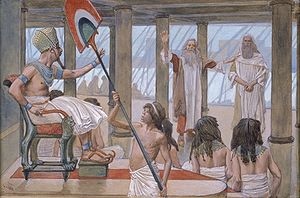
Moses Speaks to Pharaoh (watercolor circa 1896-1902, James Tissot)


  Now by this time the Egyptian people have suffered much and they begged the Pharaoh to let the Israelites go. When Moses comes with the warning of the eighth plague, Pharaoh says: You say that you want to serve your G_d? I'll let the men go, as long as the women and children stay behind. No, says Moses, we must all go, men, women, children, cattle and herds. Pharaoh once again refuses.

 The eighth plague that Moses warned of is the plague of locusts. It began on day 1 of the Hebrew month of Shevat. But before the plague came to be G_d told Moses that from that point on He would " harden the Pharaoh's heart" so that the Pharaoh would not give in and the remaining miracles (the final plagues and the parting of the Red Sea) would happen.

  G_d has Moses stretch out his staff over Egypt and the wind picked up from the east. The wind continued until the next day, when it brought a swarm of locusts. The swarm was so thick that it cast a shadow over Egypt. What was left of Egyptian crops were consumed by the locusts, leaving no plant or tree standing. Again Moses was asked to remove the locusts with the promise of religious worship for the Israelites and this time G_d blew them into the Red Sea. And as promised by G_d the Pharaoh's harden heart said no.

  In the ninth plague is darkness. G_d commanded Moses to stretch his hands toward the sky to bring darkness upon Egypt. It was so heavy that the Egyptians could feel it. This lasted for three days, during which time there was light in the homes of the Israelites. Moses is called by the Pharaoh and offered to let the Israelites leave, if only the darkness is removed from the land. However, he requires that the sheep and cattle stay. Moses refused, and went on to say that the Pharaoh would soon be offering to provide animals for sacrifice. This enraged the Pharaoh, who then threatened to execute Moses if he should again appear before the Pharaoh again. Moses replied that he would not.

  This plague was an attack on the Egyptian sun god Ra. By introducing the plague of darkness, Moses attempted to demonstrate the clear power of G_d and the folly of worshiping Egyptian gods.

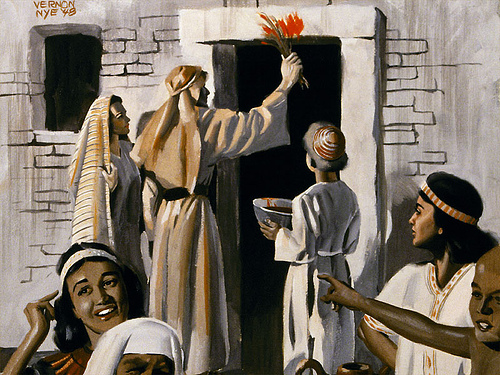
  Before the final plague, the death of the firstborn, G_d has Moses tell the Israelites to mark lamb's blood on the doorposts of every door in which case the Lord will pass over them and they will not "suffer the destroyer to come into your house and smite you", thus sparing all the firstborns of the Israelites. This happened a the stroke of midnight of the 15th of the month of Nisan. This was the hardest blow to Egypt and the plague that not only took the Pharaoh's firstborn but it finally convinced to let the Israelites go.

  As Moses quickly leads the Israelites out of Egypt, the Pharaoh changes his mind and send soldiers to retrieve his former slaves As the Egyptian army approaches the fleeing Israelites at the edge of the Red Se the final miracle happens: G_d parts the Red Sea, allowing Moses and his followers to cross safely, then closes the passage and drowns the Egyptians. According to the Jewish Bible, the Israelites- now numbering in the hundreds of thousands- then traveled through the Sinai desert for 40 tumultuous years before reaching their ancestral home of Canaan, later known as the Land of Israel.


   The day before Passover is known as the Fast of the Firstborn, a minor fast commemorating the fact that the firstborn sons of Jewish households were not killed in Egypt during the final plague.

  On the first night of Pesach there is a special family meal filled with a ritual to remind Jews of the significance of the holiday. This is what is called a seder, from the Hebrew root word for "order", because there is a specific set of information that must be discussed in a specific order. It is the same root from which the word "siddur" (prayer book) is derived.


  Passover (Pesach) is divided into two parts:

  The first two days and the last two days (the latter commemorating the parting of the Red Sea) are full fledged holidays. Holiday candles are lit at night and kiddush* and wonderful holiday meals are enjoyed on both nights and days. However, Jews don't go to work, drive, turn on or off  electrical appliances ( some appliances now come with a Shabbat mode*) and write. But cooking and to carry outdoors*.


  The middle four days are called chol hamoed,  semi-festive "intermediate days", when most forms of work is allowed.

Chametz


  What is probably the most significant part of Passover is the avoidance of chametz, leaven bread. This commemorates the unleavened bread that the Israelis ate when they left Egypt, because there was no time for their bread to rise. Jews don't keep any kind of chametz from midday the day before Passover to the end of the holiday. This also includes not having any kind of food or drink that contains leavened grain such as, cakes, breads, cookies, cereal, pasta, and most alcoholic drinks, beer, Scotch, etc. And almost all process food can be considered chametz, unless otherwise stated.

  Ridding the home of chametz is an intensive process. It involves a full on spring-cleaning mission weeks before the holiday and climaxes with the search for chametz on the night before Passover and the burning of the chametz ceremony the morning before the holiday. Chametz that cannot be disposed of can be sold to a non-Jew for the duration of Passover.

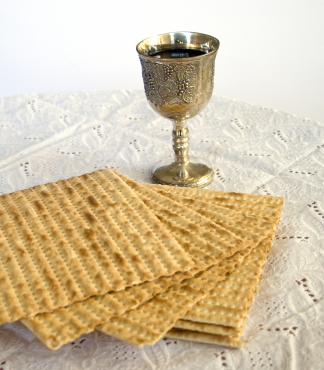
Matzah and Kiddush Cup


  Instead of eating chametz, Jews eat matzah, a flat unleavened bread. It is a mitzvah* to partake in matzah on the two Seder nights and during the rest of the holiday it is optional.


  The highlight of Pesach is the Seder, which is observed on the first two nights of the holiday. The Seder is a 15 step family-oriented tradition and ritual packed meal. They are:
  1. Kaddesh : Sanctification - A blessing over wine in honor of the holiday. The wine is drunk and the second cup is poured.
  2. Urechatz : Washing - A washing of the hands without a blessing in preparation for eating karpas. 
  3. Karpas : Vegetable - Parsley dippedJewish people. The salt water represents the tears that they shed in slavery.
  4. Yachatz : Breaking - One of the three matzahs on the table is broken. Part is returned to the pile the other is set aside for afikomen.
  5. Maggid : The story - The retelling of the Exodus out of Egypt and the first Passover. This begins with   the youngest child present asking the Four Questions also known as Mah Nishtanah ( Why is it different?)*, but if there are no children at the Seder then anyone can ask. The maggid is designed to satisfy the needs of four different types of people : the wise one, who wants to know the technical details; the wicked one, who excludes himself (and learns the penalty for doing this); the simple one, who needs to know the basics; and the one who is unable to ask, for he doesn't even know enough to know what he needs to know.  At the end of the maggid a blessing is said over the second cup of wine and it is drunk.
  6. Rachtzah : Washing - Second washing of the hand, but with a blessing, in prepparation of the eating of the matzah. 
  7. Motzi : Blessing over grain products - The ha-motzi blessing is a generic blessing for bread or grain products used as a meal, is recited over the matzah.
  8. Matzah : Blessing over Matzah - A specific matzah blessing is recited and a bit of matzah is eaten.
  9. Maror : Bitter Herbs - Blessing recited over a bitter vegetable, usually raw horseradish and it 's eaten. This symbolizes the bitterness of slavery.The maror is dipped in charoset, a mixture of apples, nuts, cinnamon and wine, which is symbolic of the mortar used by the Jews during slavery.
  10. Korekh : The Sandwich -  Rabbi Hillel* was of the opinion that the maror should be eaten together between  two pieces of matzah . In his honor, some maror is put on a small piece of matzah, with some charoset, and eaten.
  11. Shulchan Orekh : Dinner- The festive meal is eaten.Traditionally this begins with the charred egg on the Seder plate. Otherwise, with the exception of chamez,there is no particular requirement regarding what to eat at this meal. Some Jewish Families serve matzah ball soup, while others may serve turkey or beef brisket.
  12. Tzafun : The Afikomen - This is the piece of matzah that was set aside earlier and is now eaten as 'dessert', the last food of the meal. Different families have different customs when it comes to the afikomen. In some families the parents hide the piece of matzah and the children go in search of it and in other families, the children hide it and the parents go and look for the matzah. But mainly it is the children who do the searching because the adults want them to stay awake and attentive throughout the pre-meal proceedings, waiting for this part.
  13. Barekh - Grace After Meals - The third cup of wine is poured and the birkat ha-mazon (grace after meals) is recited. This is similar to the grace that would be said on any Shabbat. At the end, a blessing is said over the third cup of wine and it's drunk. The fourth cup is poured, including a cup set aside for the prophet Elijah, who is supposed to have herald the Messiah and is supposed to come on Pesach to do this. The door is opened for a while at this point for Elijah.
  14. Hallel : Praises - Several psalms are recited. And a last blessing is recited over the cup of the last wine and it is drunk.
  15. Nirtzah : Closing -  A simple statement that the Seder has been completed, with a wish that next year, that the Jews may celebrate Pesach in Jerusalem. This is followed by various hymns and stories.
 
* kiddush - A blessing recited over a cup of wine

* Shabbat (Sabbath) mode -  a feature in many modern home appliances, including refrigerators and ovens, which is intended to allow the appliance to be used ( subject to various constraints) by Shabbat-observant Jews on the Shabbat or and Jewish holidays. Observant Jews interpret the Jewish law forbidding them from doing creative work on the Shabbot, to include making a fire, preparing meals or even closing a switch or pressing a button.


*Mitzvah - Refers to precepts and commandments as commanded by G_d. Any of the 613 commandments that Jews are obligated to observe. It can also refer to any Jewish religious obligation or more generally, any good deed.

* The Four Questions (Mah Nishtanah) :
1. Why is it on all other nights during the year we eat either leavened bread or matzah, but on this night we eat only matzah? We eat only matzah because our ancestors could not wait for their breads to rise when they were fleeing slavery in Egypt and so they were flat when they came out of the oven.

 2. Why is it that on all other nights we eat all kinds of vegetable, but on this night we eat bitter herbs? We eat only Maror, a bitter herb, to remind us of the bitterness of slavery that our ancestors while in Egypt.

3. Why is it that on all other nights we do not dip [our food] even once, but on this night we dip them twice? The first dip, green vegetable in salt water, symbolizes the replacing of our tears with gratefulness and the second dip, maror in charoset, symbolizing the sweetening of our burden of bitterness and suffering.

4. Why is it that on all other nights we dine either sitting upright or reclining, but on this night we all recline? We recline at the Seder table because in ancient times, a person who reclined at a meal was a free person, while slaves and servants stood.

* Rabbi Hillel - A famous Jewish religious leader leader born around 110 B.C.E.in Babylon and died 10 CE. in Jerusalem. He is responsible for the Golden Rule. For more information about Hillel the Elder : http://www.jewishencyclopedia.com/articles/7698-hillel


Sunday, April 1, 2012

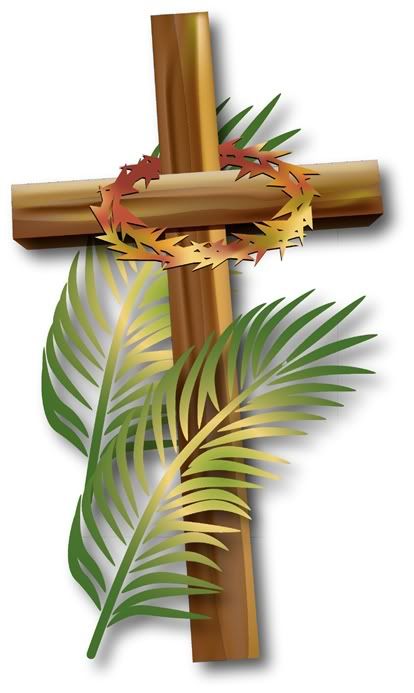
Palm Sunday 2012

  Here is wish you and yours a happy and blessed Palm Sunday.


Jesus entering Jerusalem


Thursday, March 1, 2012

Saint David


  Saint David ( 462,487 or.500-589) in Welsh Dewi Sant. The life story and legends of Saint David are based largely on Rhygyfarch story Buchedd Dewi of the late 11th century. Rhygyfarch claimed it was based on documents found in the cathedral.However, some modern historians are skeptical of its claims: one of Rhygyfarch' aims was to establish some independence for the Welsh church, which had refused the Roman rite until the 8th century and now, following the Norman invasion of 1066, was to seek a metropolitan status equal to that of Canterbury.


 In accordance to accepted general legend, Saint David as the product of rape. His mother is a lady of Irish noble birth living in Dyfed. who went by the name Lady Non. She had taken the religious life, joining convent at Ty Gwyn near Whitesands Bay. However, her beauty brought her the unwanted attention of Sandde, prince of the Kingdom Ceredigion, who was traveling nearby. His advances to Non were vehemently rejected by her but to no avail, for he forced himself upon her.
Statue of St. Non


  As a result of the attack on Non, she became pregnant with St. David: a man of such holiness that while still in his mother's womb he was able to perform miracles. An old story tells of when Non, during her pregnancy, entered a church to listen to the preachings of a local priest  and the man was immediately struck dumb. Because her child was soon to excel all religious leaders,the cleric found himself unable to continue in the presence of the great man.

  St. David's birth was no less miraculous, for at the time of his birth Non had went into hiding and gave birth to him at Caerfrai, on the coast just south of Mynyw (St.Davids), in the middle of a violent storm. During his birth, Non pressed her fingers so hard into the rock beside her that she left an impression. A baby boy was born in a sea of brilliant light and the boulder was split in two by a bolt of lighting. Non named her son Dewidd but was commonly called Dewi. David is English for the Latin name Davidus.

 A chapel was built where Dewi was born and its ruins can still be seen today. St. Non's Well, having her statue, is nearby.

St. Non's Well in St. Davids, Pembrokeshire, Wales

 David was brought up by his mother in Henfynyw, near Aberaeron and, at a young age, was baptized by his maternal cousin, St. Eiflyw. While at Henfynyw, Non and St. David founded a nunnery at nearby Llanon.

 Saint David may have been educated by St. Colman of Dromore, but to some, this seems unlikely.

  David was greatly attracted to the Welsh Church and a soon as he had reached adulthood he beacame a priest. He traveled to  the island of Wincdi-Lantquendi ( possibly Whitland) in order to study under St. Paulinus of Wales. David stayed there for ten years and possibly also studied under St. Illtud at Llanilltud Fawr ( Llantwit Major) around this time. He was a star pupil, even curing Paulinus of of his blindness.

  Saint David then began his travels of Wales, preaching the Gospel along the way. He is said to have founded 12 monasteries, though many finds are said to be in error by later claims. 20th century researcher and genealogist PC Bartum suggest that possible genuine foundations may have included Glasgwm (Elfael, a Welsh kingdom), Colfa  (Elfael), Llangyfeach (Gwyr), Llanarthe (Ystrad Tywi),and Betws ( Ystrad Twyi). Saint David also visited the court of  the King Proprius of Ergyng and cured his blindness as well.

  David eventually returned home to Henfynyw where he met up with his relation, Bishop Gwestlan. The two ere companions and neighbors for some time, before Saint David moved to nearby, Rhoson Uchaf near Mynyw (St. Davids). He was accompanied by a number of disciples including Aeddan, a Pictish overlord, Teilo and Ysfael, and together they founded the monastery of Mynyw. An Irish cieftan, named Bwya, living near the monastery at Castell Penlan, was not happy about the invasion of the monks and planned to drive them out. As planned out, his wife sent her maidservants to bathe in the River Alun in order to tempt David and his followers, but the clerics were not impressed. Soon a sting of bad luck befell the Irish couple and David was able to settle down without any further harassment.

The River Alun


  By this time, St. David's fame as a spiritual leader was becoming widespread  throughout Britain. He had became known as "the Waterman" - David Aquaticus (Dewi Dyfyrwr) - because he encouraged his followers to bathe, drink and live in cold water. He attracted  from many walks of life, like retires monarch Saint Constantine of Dmmonia . From Henfynyw , they spread the Word of God, travelling across the countryand especially to Ireland. St. Aeddan crossed the Irish Sea and found the monastery of Ferns from where he received a premonition that St. David was about to be poisoned. He sent his companion, Ysgolan, to save David from assassination. Other Irish visitors, including Bishop Barre,to whom David lent a miraculous horse that carried him home across the sea.

 David then decided to take a pilgrimage to Jerusalem with Sts. Teilo and Padam . It is said that they were there consecrated bishops by the patriarch. Upon his return to Wales, in AD 545, Saints Deiniol, Bishop of Bangor Fawr, and Dyfrig, Archbishop of Ergyng (and said to be the Bishop of Wales) persuaded St. David to attend the Synod of Llandewi Brefi, which had been convene to discuss the discipline within the church and to stamp out the Pelagian Heresy* . St. Paulinus of Wales had recommended his old student, since St. David's six foot stature made him ideal for addressing the vast crowds.  The story goes that David spoke so eloquently before his peers that a hill miraculously raised up under him. Dyfrig resigned his Archiepiscopate immediately in David's favor; and he moved the cathedral from Caerleon to his own foundation at Mynyw.  St. Gildas is said to have disputed the appointed, but Saints Cadog and Finnian of Clonard  ruled in favor of David.  It appears to be unlikely that an archiepiscopal see existed in Wales at this time, but David's monastery does seem to have eclipsed the influence of the more easterly church. A second synod, of Victoria, was summoned in AD 569,to re-assert the anti -pelagian decrees agreed at Brefi.

  It is possible that David visited Glastonbury in Somerset. He had learned of the abbey great sanctity and wished to dedicate the building. However, upon his arrival, St. David had a dream in which the Lord  appeared to him and told him that he had already dedicated the church in honor of His mother, Saint Mary. So, St. David  instead decided to extend the 'Old Church' erected by St. Joseph of Arimathea and erected a more extensive building to the east.

  Saint David died on a Tuesday March 1, 589.  The monastery is said to have been ' filled with angels as Christ received his soul'. His last words to his followers were from his last sermon on the previous Sunday. Rhygyfarch transcribes these as " Be joyful, and keep your faith and your creed. Do the little things you have seen me do and heard about. I will walk the path that our fathers have trod before us. " " Do the little things in life" ( Gwnewch y pethau bychain mewn bywyd) is today a well-know phrase in Wales. 

  St. David is buried at St. David's Cathedral at St. Davids, Pembrokeshire, where his shrine was a popular pilgrimage site during the Middle Ages. "It was so important that medieval Pope Calixtus II decreed that two pilgrimages there were equivalent to one trip to Rome. Three visits to the hallowed spot were the equivalent to one pilgrimage to Jerusalem."*In the 10th and 11th centuries the Vikings frequently raided the cathedral removing the shrine and stealing the precious metal adornments on it. A new shrine was built in 1275, the ruined base of it remains to this day, which was originally topped with an ornamental wooden canopy with murals of St. Patrick, St. David and St. Denis of France. The relics of St. David and St. Justinian were kept in a portable casket on the stone base of the shrine. It was this shrine that Edward I came to pray in 1284.  It was during the Reformation that Bishop Barlowe, a staunch Protestant, stripped St. David's shrine of its jewels and confiscated the relics of Sts. David and Justinian.


  Saint David is the patron saint of Wales, Pembrokeshire, vegetarians and poets.


St. David's flag. A Illuman glan Dewi a ddyrchafant ( And they will raise the pure banner of Dewi)


  St. David's Feast Day is March 1 in remembrance of the day of his death. On this day, it is the tradition in Wales for the children to take part in school concerts, known as eisteddfodau, with recitation and singing being the main activities.  Formery, a half day holiday was given to school children. Officialy this custom no longer continues but has become a school-by-school decision.

  Additionally,various Regiments of the British Army make use of aspects of St. David's cross, St. David himself, or songs of St. David in their formalities during the celebrations. Many Welsh people wear one or both of the national emblems of Wales on their lapels to honor St. David : the daffodil ( a generic Welsh symbol which is in season during March) or the leek (St. David's personal symbol) on this day. The leek rises from the occasion when a troop of Welsh were able to distinguish one another from the English enemy, who were dressed in similar fashion, by wearing leeks. The association between the leek and daffodil is strengthened by the fact that they have similar names in Welsh, Cenhinen (leek) and Cenhinen Pedr (daffodil, literally meaning Peter's leek). Sometimes the younger girls will were traditional Welsh costumes to school. It consists of a long woolen skirt, white blouse and a Welsh cap.

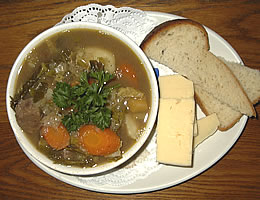
Cawl, a Welsh stew made of meat and vegetables. Even though the ingrediets can vary, it is common to use lamb and leeks, is frequently made on St. David's Day.

cawl