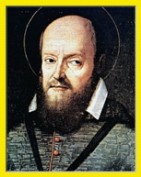
Saint David ( 462,487 or.500-589) in Welsh Dewi Sant. The life story and legends of Saint David are based largely on Rhygyfarch story Buchedd Dewi of the late 11th century. Rhygyfarch claimed it was based on documents found in the cathedral.However, some modern historians are skeptical of its claims: one of Rhygyfarch' aims was to establish some independence for the Welsh church, which had refused the Roman rite until the 8th century and now, following the Norman invasion of 1066, was to seek a metropolitan status equal to that of Canterbury.
In accordance to accepted general legend, Saint David as the product of rape. His mother is a lady of Irish noble birth living in Dyfed. who went by the name Lady Non. She had taken the religious life, joining convent at Ty Gwyn near Whitesands Bay. However, her beauty brought her the unwanted attention of Sandde, prince of the Kingdom Ceredigion, who was traveling nearby. His advances to Non were vehemently rejected by her but to no avail, for he forced himself upon her.
Statue of St. Non
As a result of the attack on Non, she became pregnant with St. David: a man of such holiness that while still in his mother's womb he was able to perform miracles. An old story tells of when Non, during her pregnancy, entered a church to listen to the preachings of a local priest and the man was immediately struck dumb. Because her child was soon to excel all religious leaders,the cleric found himself unable to continue in the presence of the great man.
St. David's birth was no less miraculous, for at the time of his birth Non had went into hiding and gave birth to him at Caerfrai, on the coast just south of Mynyw (St.Davids), in the middle of a violent storm. During his birth, Non pressed her fingers so hard into the rock beside her that she left an impression. A baby boy was born in a sea of brilliant light and the boulder was split in two by a bolt of lighting. Non named her son Dewidd but was commonly called Dewi. David is English for the Latin name Davidus.
A chapel was built where Dewi was born and its ruins can still be seen today. St. Non's Well, having her statue, is nearby.
St. Non's Well in St. Davids, Pembrokeshire, Wales
David was brought up by his mother in Henfynyw, near Aberaeron and, at a young age, was baptized by his maternal cousin, St. Eiflyw. While at Henfynyw, Non and St. David founded a nunnery at nearby Llanon.
Saint David may have been educated by St. Colman of Dromore, but to some, this seems unlikely.
David was greatly attracted to the Welsh Church and a soon as he had reached adulthood he beacame a priest. He traveled to the island of Wincdi-Lantquendi ( possibly Whitland) in order to study under St. Paulinus of Wales. David stayed there for ten years and possibly also studied under St. Illtud at Llanilltud Fawr ( Llantwit Major) around this time. He was a star pupil, even curing Paulinus of of his blindness.
Saint David then began his travels of Wales, preaching the Gospel along the way. He is said to have founded 12 monasteries, though many finds are said to be in error by later claims. 20th century researcher and genealogist PC Bartum suggest that possible genuine foundations may have included Glasgwm (Elfael, a Welsh kingdom), Colfa (Elfael), Llangyfeach (Gwyr), Llanarthe (Ystrad Tywi),and Betws ( Ystrad Twyi). Saint David also visited the court of the King Proprius of Ergyng and cured his blindness as well.
David eventually returned home to Henfynyw where he met up with his relation, Bishop Gwestlan. The two ere companions and neighbors for some time, before Saint David moved to nearby, Rhoson Uchaf near Mynyw (St. Davids). He was accompanied by a number of disciples including Aeddan, a Pictish overlord, Teilo and Ysfael, and together they founded the monastery of Mynyw. An Irish cieftan, named Bwya, living near the monastery at Castell Penlan, was not happy about the invasion of the monks and planned to drive them out. As planned out, his wife sent her maidservants to bathe in the River Alun in order to tempt David and his followers, but the clerics were not impressed. Soon a sting of bad luck befell the Irish couple and David was able to settle down without any further harassment.
The River Alun
By this time, St. David's fame as a spiritual leader was becoming widespread throughout Britain. He had became known as "the Waterman" - David Aquaticus (Dewi Dyfyrwr) - because he encouraged his followers to bathe, drink and live in cold water. He attracted from many walks of life, like retires monarch Saint Constantine of Dmmonia . From Henfynyw , they spread the Word of God, travelling across the countryand especially to Ireland. St. Aeddan crossed the Irish Sea and found the monastery of Ferns from where he received a premonition that St. David was about to be poisoned. He sent his companion, Ysgolan, to save David from assassination. Other Irish visitors, including Bishop Barre,to whom David lent a miraculous horse that carried him home across the sea.
David then decided to take a pilgrimage to Jerusalem with Sts. Teilo and Padam . It is said that they were there consecrated bishops by the patriarch. Upon his return to Wales, in AD 545, Saints Deiniol, Bishop of Bangor Fawr, and Dyfrig, Archbishop of Ergyng (and said to be the Bishop of Wales) persuaded St. David to attend the Synod of Llandewi Brefi, which had been convene to discuss the discipline within the church and to stamp out the Pelagian Heresy* . St. Paulinus of Wales had recommended his old student, since St. David's six foot stature made him ideal for addressing the vast crowds. The story goes that David spoke so eloquently before his peers that a hill miraculously raised up under him. Dyfrig resigned his Archiepiscopate immediately in David's favor; and he moved the cathedral from Caerleon to his own foundation at Mynyw. St. Gildas is said to have disputed the appointed, but Saints Cadog and Finnian of Clonard ruled in favor of David. It appears to be unlikely that an archiepiscopal see existed in Wales at this time, but David's monastery does seem to have eclipsed the influence of the more easterly church. A second synod, of Victoria, was summoned in AD 569,to re-assert the anti -pelagian decrees agreed at Brefi.
It is possible that David visited Glastonbury in Somerset. He had learned of the abbey great sanctity and wished to dedicate the building. However, upon his arrival, St. David had a dream in which the Lord appeared to him and told him that he had already dedicated the church in honor of His mother, Saint Mary. So, St. David instead decided to extend the 'Old Church' erected by St. Joseph of Arimathea and erected a more extensive building to the east.
Saint David died on a Tuesday March 1, 589. The monastery is said to have been ' filled with angels as Christ received his soul'. His last words to his followers were from his last sermon on the previous Sunday. Rhygyfarch transcribes these as " Be joyful, and keep your faith and your creed. Do the little things you have seen me do and heard about. I will walk the path that our fathers have trod before us. " " Do the little things in life" ( Gwnewch y pethau bychain mewn bywyd) is today a well-know phrase in Wales.
St. David is buried at St. David's Cathedral at St. Davids, Pembrokeshire, where his shrine was a popular pilgrimage site during the Middle Ages. "It was so important that medieval Pope Calixtus II decreed that two pilgrimages there were equivalent to one trip to Rome. Three visits to the hallowed spot were the equivalent to one pilgrimage to Jerusalem."*In the 10th and 11th centuries the Vikings frequently raided the cathedral removing the shrine and stealing the precious metal adornments on it. A new shrine was built in 1275, the ruined base of it remains to this day, which was originally topped with an ornamental wooden canopy with murals of St. Patrick, St. David and St. Denis of France. The relics of St. David and St. Justinian were kept in a portable casket on the stone base of the shrine. It was this shrine that Edward I came to pray in 1284. It was during the Reformation that Bishop Barlowe, a staunch Protestant, stripped St. David's shrine of its jewels and confiscated the relics of Sts. David and Justinian.
Saint David is the patron saint of Wales, Pembrokeshire, vegetarians and poets.
St. David's flag. A Illuman glan Dewi a ddyrchafant ( And they will raise the pure banner of Dewi)
St. David's Feast Day is March 1 in remembrance of the day of his death. On this day, it is the tradition in Wales for the children to take part in school concerts, known as eisteddfodau, with recitation and singing being the main activities. Formery, a half day holiday was given to school children. Officialy this custom no longer continues but has become a school-by-school decision.
Additionally,various Regiments of the British Army make use of aspects of St. David's cross, St. David himself, or songs of St. David in their formalities during the celebrations. Many Welsh people wear one or both of the national emblems of Wales on their lapels to honor St. David : the daffodil ( a generic Welsh symbol which is in season during March) or the leek (St. David's personal symbol) on this day. The leek rises from the occasion when a troop of Welsh were able to distinguish one another from the English enemy, who were dressed in similar fashion, by wearing leeks. The association between the leek and daffodil is strengthened by the fact that they have similar names in Welsh, Cenhinen (leek) and Cenhinen Pedr (daffodil, literally meaning Peter's leek). Sometimes the younger girls will were traditional Welsh costumes to school. It consists of a long woolen skirt, white blouse and a Welsh cap.
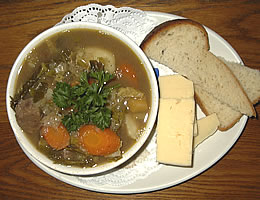
Cawl, a Welsh stew made of meat and vegetables. Even though the ingrediets can vary, it is common to use lamb and leeks, is frequently made on St. David's Day.
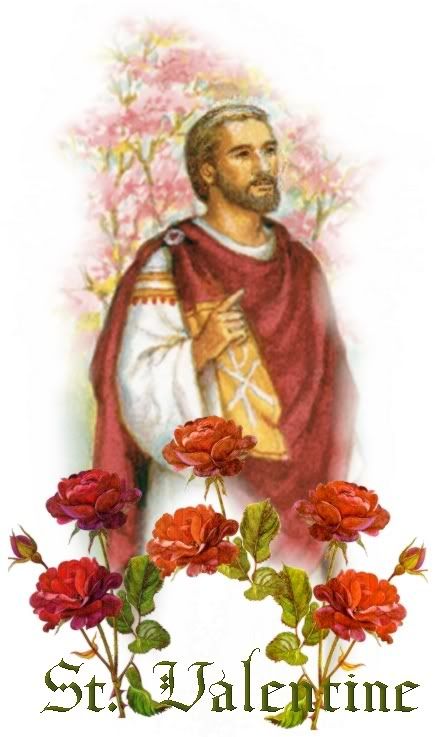
Saint Valentine's Day is about as mysterious as love itself. The facts concerning the holiday has been questioned by both scholars and religious historians.
At the heart of the matter is actual identity of St. Valentine himself. For in the time of ancient Rome, there were 14 martyred saints with the name, Valentine. But which one was he? Of the Saint Valentine whose feast day is February 14, all that is known is his name, that he was buried on the Via Flaminia* north of Rome on February 14 and that he was born on April 16. And really it is not even certain that February 14 feast day is for one St. Valentine or two. It is for this reason this liturgical commemoration* was not kept in the Catholic Church 's Calender of Saints. But "Martyr Valentinus the Presbyter* and those with him in Rome" remain on a list proposed for veneration by all Catholics.
In the Eastern Orthodox Church, St. Valentine the Presbyter is celebrated on July 6 and Hieromatyr* Saint Valentine ( Bishop of Interramna, Terni, Turkey) is celebrated on July 30. And Greek Orthodox Church members whose name is Valentina (female) or Valentinos (male) celebrate their nanes on February 14.
Now since there are so many different Valentines, the Catholic Church's Roman Martyrology only mentions one St. Valentine for February 14.
And according to the Church he was the Bishop of Terni, a city in southern Umbria, in what is now central Italy. While under house arrest of judge Asterius,and talking about his faith with judge Asterius, Valentinus (Roman pronunciation), was discussing the validity of Jesus. The judge put Valentinus to a test and brought to him the judge's adopted blind daughter. If Valentinus could restore the girl's sight the judge would do anything he asked. Valentinus layed his hands on the blind girl's eyes and her vision was restored. The judge was immediately humbled and asked Valentinus what he wanted. His reply was to have all the idols in the judge's house destroyed, the judge should fast for three days and then be baptized. The judge obeyed and as a result, released all the Christian inmates under his authority. Unfortunately, Valentius was once again arrested for continuing to serve Jesus and was sent to the prefect of Rome, Emperor Claudius, himself. Now Claudius did take a liking to Valentinus until he tried to convert Claudius, whereupon Claudius refused and condemmed Valentinus to death. Valentinus was commanded to either renounce his faith or face death by being beaten with clubs and being beheaded. Valentinus refused and Claudius had him executed outside the Flaminian Gate on February 14, 269.
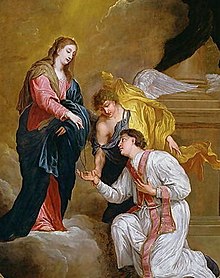
St. Valentine Receives a Rosary From the Virgin by David Teniers III
* Via Flaminia - Ancient Roman Road leading from Rome over the Apennine Mountains to Rimini, on the Adriatic Sea.
* liturgical commemoration - The recital of a part of the Office or Mass assigned to a certain feast or day when the whole can not be said.
* Presbyter - In the New Testament it is meant as a leader of a local Christian congregation. In moderen times, it's synonymous with priest, elder, minister or pastor.
* Hieromartyr - In Eastern Orthodox a martyr who is also a member of the clergy ( priest, deacon or bishop).
Saint Lucy, Saint Lucia or Santa Lucia was born in Syracuse, Sicily to a wealthy Christian noble family in 283. Saint Lucy's Roman father died while she was still an infant, leaving her and her mother,Eutychia, without a protective guardian. Even so, Eutychia took singular care of Saint Lucy and furnished her with sublime and tender sentiments of piety and religion. Because of the early impressions Saint Lucy received and the strong influence of divine grace, she discovered no disposition but towards virtue and she was yet very young when she made her vow to God to stay a virgin. However, Saint Lucy kept this vow from her mother, who was pressing her to marry a young man, who happened to be a pagan. The saint sought occasions to prevent this marriage from taking place. Because Eutychia had suffered with dysentery for four years Saint Lucy was able to convince her mother to go to the tomb of Saint Agatha, patroness of Catania, and offered their prayers all night to God for relief from dysentery, until they both fell asleep. Saint Agatha came to Saint Lucy in a vision and said "You shall be the glory of Syracuse, as I am of Catania." It was at that instant Eutychiha was cured.
Immediately following this Saint Lucy told her mother of her desire to devote herself to God in a state of perpetual virginity and bestowing her fortunes on the poor.In gratitude Eutychia gave Saint Lucy the liberty to follow her heart's desire. News of her distribution of her father's inheritance and jewels came to the ears of Saint Lucy's intended from a talkative nurse, that Saint Lucy had found a nobler Bridegroom.
This enraged Saint Lucy's promised bridegroom and he denounced her as a Christian to the magistrate, Paschasius, who ordered her to burn a sacrifice of an image of the emperor. Saint Lucy refused saying "I offer to Him myself, let Him do with His offering as it pleases Him." She was then commanded to be exposed to prostitution in a brothel, to which Saint Lucy asserted:
"No one's body is polluted so as to endanger the soul if it has not pleased the mind. If you were to lift my hand to your idol and so make me offer against my will, I would still be guiltless in the sight of the true God, who judges according to the will and knows all things. If now, against my will, you cause me to be polluted,a twofold purity will gloriously imputed to me. You cannot bend my will to your purpose; whatever you do with my body, that cannot happen to me."
However, the guards could not move Saint Lucy, even when they hitched to a team of oxen, because she had become filled with the Holy Spirit. Even when she had daggers plunged into her throat Saint Lucy prophesied against her persecutor. One legend claims that her eyes were gouged out by either the tyrannical government official or her jilted intended. Another story says that she tore her eyes out herself and gave them to her pagan suitor so he would leave her alone. In every story, however, God would restore her eyes to her, more beautiful than ever. Saint Lucia died on December 13,304.
The emblem of the eyes on the plate or cup must be linked to the popular devotion to her, as protector of sight, because her name, Lucia, comes from the Latin word for "light", lux. Lucy's name also played a large part in naming her patron saint of the blind and those with eye trouble. She is patroness of Syracuse, Sicily, Italy.
Her feast day is December 13. Saint Lucia is venerated by the Roman Catholic Church, Anglican, Orthodox Christians and in the Lutheran Church. Saint Lucia is one of the seven women, aside from the Holy Mother, who is commemorated by name in the Cannon of the Mass.
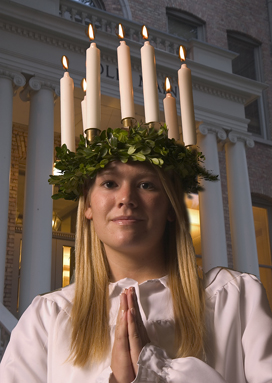
She is one of the few saints celebrated in the Lutheran Church among Scandinavians, who take part in Saint Lucy Day celebrations. In Sweden, the oldest ( or youngest) daughter in each household traditionally carries a tray of coffee and pastries called, lussekatter (Lucy cats) to her parents before they get up in the morning. She wears a white gown, scarlet sash and crown of greens and four, seven or nine lighted candles. her brothers, wearing white shirts and tall cone-shaped hats decorated with stars and and her sisters all in white carrying lighted candles, follow her.In many towns, a Saint Lucy carries coffee and buns to each house. She and her followers each carry a lighted candle, sing carols through the dark streets as Saint Steven, represented by a man on horseback, leads the way.The procession is done in honor of Saint Lucy traversing darkened woods to bring bread and other food the poor.
In Switzerland, she strolls around the village with Father Christmas, giving gifts to the girls while he gives gifts to the boys.
Italians eat small cakes or biscotti shaped like eyes, light bonfires, and conduct an evening candle light procession, all in honor of Santa Lucia.
In Sicily, they pay tribute to a miracle performed by Santa Lucia during the famine of 1582. At that time she brought a flotilla of grain bearing ships to a starving Sicily, whose citizens cooked and ate the wheat without taking the time to grind it into flour. Thus, on Saint Lucy Day, Sicilians do not eat anything made with wheat flour. Instead they eat cooked wheat called cuccia
SANTA LUCIA (Original Italian lyrics)
Sul mare luccia l'astro d'argento
Placida e l'onda , prospero e il vento
Sul mare luccia l'astro d'argento
Placida e l'onda, prospero e il vento
Venite all'agile barchetta mia
Santa Lucia! Santa Lucia!
Venite all'agile barchetta mia
Santa Lucia! Santa Lucia!
Con questo zeffiro , cosi soave
Oh, com e bello star sulla nave!
Con questo zeffiro, cosi soave
Oh com e bello star sulla nave!
Su passegieri, venite via!
Santa Lucia! Santa Lucia!
Su passegieri, venite via!
Santa Lucia! Santa Lucia!
In fra le tende, badir la cena
In una sera cosi serena
In fra le tende, badir la cena
In una sera cosi serena
Chi non dimanda, chi non desia
Santa Lucia! Santa Lucia!
Chi non dimanda, chi non desia
Santa Lucia! Santa Lucia!
Mare si placida, vento si caro
Scordar fa i triboli al marinaro
Mare si placida, vento si caro
Scordar fa i triboli al marinaro
E va gridando con allegria
Santa Lucia! Santa Lucia!
E va gridando con allegria
Santa Lucia! Santa Lucia!
O dolce Napoli, o suol beato
Ove sorridere volle il creato
O dolce Napoli, o suol beato
Ove sorridere volle il creato
Tu sei l'impero dell'armonia
Santa Lucia! Santa Lucia!
Tu sei l'impero dell'armonia
Santa Lucia! Santa Lucia!
Or che tardate? Bella e la sera
Spira un auretta fresca e leggiera
Or che tardate? Bella e la sera
Spira un auretta fresca e leggiera
Venite all'agile barchetta mia
Santa Lucia! Santa Lucia!
Venite all'agile barchetta mia.
Santa Lucia! Santa Lucia!
(ENGLISH TRANSLATION)
On the sea shimmers the silver star
The wave is peaceful, prosperous wind.
On the sea shimmers the silver star
The wave is peaceful, prosperous wind.
Come quickly my boat.
Saint Lucy! Saint Lucy!
Come quickly my boat.
Saint Lucy! Saint Lucy!
With this breeze so gentle
Oh, how beautiful to be on the ship!
With this breeze so simple
Oh, how beautiful to be on the ship!
Its passengers, come on!
Saint Lucy! Saint Lucy!
Its passengers, come on!
Saint Lucy! Saint Lucy!
In between the tents, dinner invitations
On such a quiet evening
In between the tents,dinner invitations
On such a quiet evening
Who does not demands, desires to those who do not.
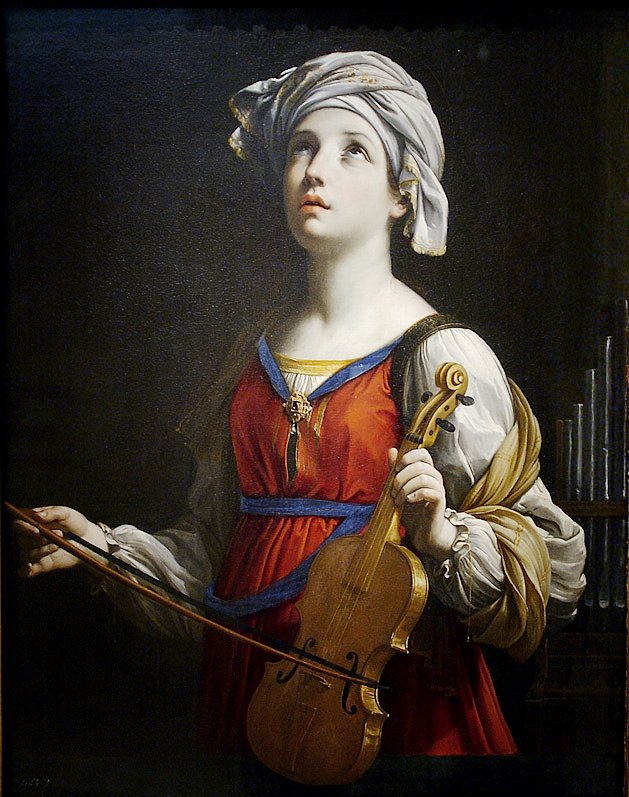
Saint Cecilia(Latin:Sancta Caecilia) is the patron saint of musicians,composers,instrument makers, music( especially Church music) and poets. The name Cecilia means blind and so, although it is not known for sure if she could see or not, she is also the Catholic patron saint of the blind. Saint Cecilia is the patron saint of music because as she was dying she sang to God. It is also written that when she was forced to marry Valerian, a pagan, she "sang in her heart to the Lord" as the musicians played. Her feast day is November 22 . She is one of seven women, excluding the Virgin Mary,commemorated by name in the Canon of the Mass.
It is believed that Saint Cecilia was born in the 2nd or 3rd century A.D. A religious romance telling the love story of Saint Cecilia and Valerian appeared in Greece in the 4th century A.D., and there is a biography of Saint Cecilia from the 5th century A.D. She is said to have been the daughter of a wealthy Roman family, a Christian from birth, who was promised in marriage to Valerian. Cecilia, however, had vowed her virginity to God and wore sackcloth, fasted and prayed in hopes of keeping this promise. Saint Cecilia told her husband of her wishes on their wedding night. She also told him that an angel watched over her to guard her purity. He wanted to see the angel, so Saint Cecilia sent him to Pope Urban Accounts on how and when Valerian saw the angle vary, but one states that Pope Urban baptized him and upon his return to Saint Cecilia, he saw her praying in her chamber and an angel by her with flaming wings, holding two crowns of lilies and roses, which he placed on their heads and then vanished. Another version says that Valerian's brother, Tibertitus, sees the crowns and is also converted.
After their conversion, the two brothers made it their mission to bury the martyrs that were daily being put to death by the prefect of the city, Turcius Almachius ( there was no prefect of that name). When the prefect heard of the brothers doings, he had them arrested and brought before the prefect, when Valerian and Tibertitus refused to sacrifice to the gods, they were executed by the sword. In the meantime, Saint Cecilia continued with making conversions of 400 people, who Pope Urban immediately baptize. She also prepared her home to become a church at her death.Then she was arrested and brought before the prefect.He ruled that she should die by suffocation in the baths. She was shut in for a day and a night and the fires were heaped up and made to glow and roar to their utmost, but Saint Cecilia did not perspire through the heat. Since she was still alive she was the ordered to be beheaded, but the executioner struck Saint Cecilia 3 times without severing her head and she would not die without receiving the Holy Communion. This left her mortally wounded and survived for 3 more days. In this time Saint Cecilia made more conversions and people came to her cell to soak up her blood with cloths and sponges. When she died the people by her cell knew she was destined to be a saint in Heaven.
Martyrdom of Saint Cecilia, by Stefano Maderno, ca. 1599-1600
There is in Rome a church, Santa Cecilia in Trastevere, in Saint Cecilia's honor that dates from around the 5th century. Tradition holds that the church was built over her house. Her relics are believed to have been found by Pope Paschal I in 821 A.D., in the cemetery of Saint Celestas. The remains were exhumed in 1599, when Cardinal Paul Emilius Sfondrati rebuilt the Church of Saint Cecilia, and was said to be incorruptible. It was also found at this time that one hand Saint Cecilia had 2 outstretched fingers and on the other hand just a single finger, denoting her belief in the Trinity.
Facade of Santa Cecilia, a 1775 project with a 12th century belltower
I'm sorry to be late with All Saint's Day, so I thought I would combine it with All Soul's Day.
ALL SAINTS DAY
All Saints Day (also called All Hallows or Hallowmas), often shortened to All Saints, is a feast (Holy day) celebrated on November 1 in the Western Christianity and on the first Sunday after the Pentecost in Eastern Christianity in honor of all the saints known and unknown. In terms of Roman Catholic theology, the feast commemorates all those who have the beatific vision ( eternal and direct visual perception of G_d) in Heaven.
It is a national holiday in many predominately Catholic countries. The next day, All Souls' Day, commemorates the departed faithful who have not yet been purified and reached heaven. Christians who celebrate All Saints Day and All Souls Day do so in the fundamental belief that there is a prayerful spiritual bond between those in purgatory ( the Church Suffering), those in Heaven ( the 'church triumphant'), and the living (' the church militant'). Other Christian traditions define, remember and respond to the saints in different ways; for example, in the Methodist Church, saints refer to all Christians and therefore, on All Saints Day, the Church Universal (the Christian Church), as well as the deceased members of a local congregation are honored and remembered.
In the early Christian Church, Christians would celebrate the anniversary of a martyr's death for Christ-known as the saint's "birth day" - by serving an All- Night Vigil, and then celebrating the Eucharist over the tomb or the shrine at their place of martyrdom. In the fourth century, neighboring dioceses began to transfer relic, and to celebrate the feast days of specific martyrs in common. Frequently, a number of Christians would suffer martyrdom on the same day, which naturally led to joint commemoration. In the persecution of Diocletian the number of martyrs became so great that a separate day could not be assigned to each. The Church, feeling that every martyr should be venerated, appointed a common day for all. A day commemorating "All Martyrs" began to be celebrated as early as the year 270, although no specific month or date is mentioned in existing records. The first trace of a general celebration on a specific day is attested in Antioch on the Sunday after Pentecost.
Father, All-Powerful and ever-living God,
today we rejoice in the holy men and women
of every time and place.
May their prayers bring us Your forgiveness and love.
We ask this in the name of Jesus Christ Our Lord. Amen.
____________________________________________
ALL SOULS' DAY
All Souls' Day November 2 ( exceptionally on November 3) feast on which the Church on Earth prays for the souls of the faithful departed still suffering in purgatory.General intercessions for the dead are very ancient but the modern feast was probably first established by Abbot Odilio of Cluny ( in France, northwest of Lyons) for his community and later extended throughout the Church.
All Soul's Day purposely follows All Saints Day in order to shift the focus from those in Heaven to those in purgatory. It is celebrated with Masses and festivities in honor of the dead. While the Feast of All Saints is a day to remember the glories of Heaven and those there, the Feast of All Souls remind us of our obligations to live holy lives and that thee will be purification of souls destined to Heaven.
The Office of the Dead must be recited by the clergy and all Masses are of Requiem ( Mass for the Dead), except for one current feast,where this is of obligation. The theological basis for the feast is the doctrine of the souls which, on departing from the body, are not perfectly cleansed from venial sin or have not fully atoned for their past transgressions, are barred from the Beatific Vision, and the faithful on Earth can help them by prayers, almseed and especially by the sacrifice of the Mass. Souls in purgatory, who are members of the Church just like living Christians, must suffer so they can be purged of their sins.
Upon death, it's believed that souls have not yet been cleansed of sin. Praying for souls of loved ones help to remove the stain of sin and allow souls to enter Heaven. Through prayer and good work, living members of the Church may help their departed friends and family. There are three Requiem Masses said by the clergy to assist the souls from Purgatory to Heaven: one for the celebrant, one for the departed and one for the pope.
The Catholic Church has dedicated the entire month of November to the Holy Souls in Purgatory.
If you are offering the prayer to a particular person, you can substitute "him" or "her" for "them".
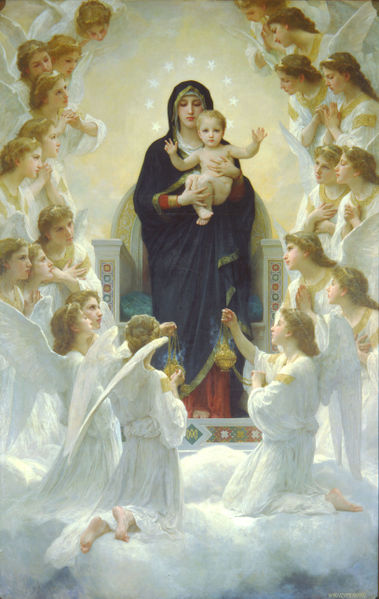
The Virgin With Angels was done in 1900 by the French artist William-Adolphe Bougereau. He was a traditionalist whose realistic genre paintings and mythological themes were modern interpretations of Classical subjects with a heavy emphasis on women.