Thank You
Nothing special. Just books,cats,flowers,teas &accessories. Plus music with maybe sports thrown in for fun.
Showing posts with label history. Show all posts
Monday, May 28, 2012
Saturday, April 7, 2012
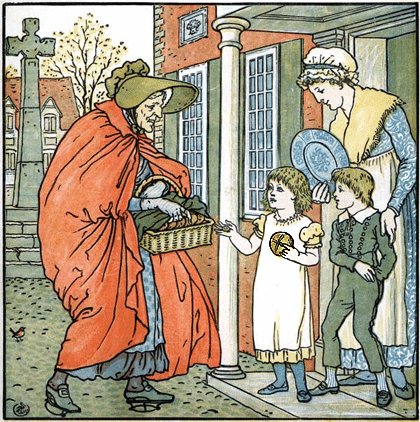
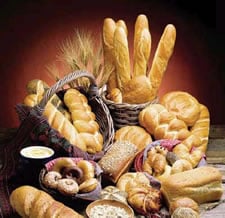
Hot Cross Buns
Hot cross buns!
Hot cross buns!
One ha' penny, two ha' penny,
Hot cross buns!
If you have no daughters,
Give them to your sons.
One ha' penny,
Two ha' penny,
Hot cross buns!
So goes the nursery rhyme with the earliest record of it in Christmas Box, published in London in 1798. However there is an even earlier reference to "Hot Cross Buns" as a street cry, for example in Poor Robin's Almanack for 1733, though many quibble over the date of their origin most agree that they predate 1733:
"Good Friday comes this month the old woman runs
With one or two penny hot cross buns"
Hot cross buns are popular in the days of Tudors, as there are specific mentions of them being allowed to be baked under certain conditions by Elizabeth I in 1592. This is because Protestant English monarch were saw the hot cross buns as a dangerous holdover of Catholic belief's in England being baked in the dough used in making communion wafers. However, maybe the most fascinating mention is in Sue Ellen Thompson's Holiday Symbols and Customs :
"When archeologists excavated the ancient city of
Herculaneum in southwestern Italy, which had been buried
volcanic ash and lava since 79 C.E., they found two small
loaves, each with a cross on it, among the ruins.
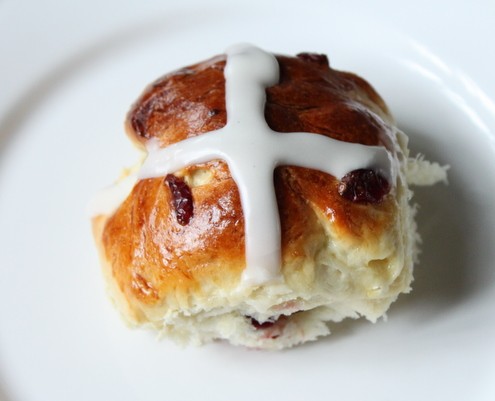
Hot cross bun is a sweet spiced bun made with raisins or currants and marked with a cross on top and is traditionally eaten on Good Friday.
In many historical Christian countries, buns are usually eaten hot or toasted on Good Friday, with the cross symbolizing the Crucifixion.
It is believed that buns marked with a cross were eaten by Saxons in honor of Eostre, Germanic goddess that is the namesake of Easter. The cross is thought to have symbolized the four quarters of the moon. Other claim that the Greeks marked cakes with a cross much earlier.
In English folklore there are many superstitions regarding the hot cross bun. One of them is that buns baked and served on Good Friday will not spoil or become moldy during the subsequent year. Another one is to keep a hot cross bun for medicinal purposes. A piece of it is given to someone who is ill and is said to help them recover.
Sharing a hot cross bun with another is supposed to be ensure friendship throughout the coming year, particularly if "Half for you and half for me, Between us two shall goodwill be" is said at that time. Because of the cross on the buns, some say they should be kissed before eaten. If taken on a sea voyage, are said to protect against shipwrecks. If hung in the kitchen, they are said to protect against fires and ensure that all breads turn out perfect. Each year the hanging bun is replaced.
In English folklore there are many superstitions regarding the hot cross bun. One of them is that buns baked and served on Good Friday will not spoil or become moldy during the subsequent year. Another one is to keep a hot cross bun for medicinal purposes. A piece of it is given to someone who is ill and is said to help them recover.
Sharing a hot cross bun with another is supposed to be ensure friendship throughout the coming year, particularly if "Half for you and half for me, Between us two shall goodwill be" is said at that time. Because of the cross on the buns, some say they should be kissed before eaten. If taken on a sea voyage, are said to protect against shipwrecks. If hung in the kitchen, they are said to protect against fires and ensure that all breads turn out perfect. Each year the hanging bun is replaced.
Friday, April 6, 2012
Pesach/Passover
Passover is English for the Jewish term Pesach, it is one of the most commonly observed Jewish holidays, even by otherwise non-observant Jews. It is an eight day festival that is celebrated in early spring, through the 15th to the 22nd of Nisan, the first of the ecclesiastical year & the 7th month (8th in a Jewish leap year).
Pesach is the first of three major pilgrimage festivals with both historical and agricultural significance. Agriculturally, it represents the beginning of harvest season in Israel, but this aspect is paid little attention. The primary observances of Pesach are told in the Exodus from Egypt after generations of slavery. It is also when the entire Jewish populace historically made a pilgrimage to the Temple of Jerusalem.
The story of Passover is old and familiar for this was the time that after decades of enslavement by the pharaohs of Egypt, in which the Israelites were subjected to backbreaking labor and other unbearable horrors. For when G_d saw the distress of His people He sent Moses, along with Aaron, Moses' older brother, to the Pharaoh to allow the Israelites to have a three-day leave so that G_d's people may celebrate a feast in the wilderness. Aaron and Moses go to the pharaoh many times with this commandment from G_d and each time the pharaoh refuses. Even when Aaron's staff is turned into a snake and eats the Pharaoh's sorcerers magic sticks, the pharaoh refuses.
After these refusals, Moses warns the pharaoh that if he does not comply with the three-day leave, G_d will smite Egypt. The pharaoh remained closed to the idea, so G_d sends a series of plagues upon Egypt, a devastating ten in total.In the attack of each plague, the pharaoh promises to let the Israelites go but always reneges on the promise the moment each affliction is removed.
| Ten Plagues of Egypt |
The first of these plagues is water turning into blood. This is done when Aaron, upon G_d's instruction, strikes the Nile with his rod and turns the water into blood. As a result, the fish in the Nile River died and other bodies of water used by the Egyptians turned to blood as well. Plus there was a terrible stench accompanying this plague. But the Pharaoh's court magicians were able to do the same thing, so this is when the Pharaoh took back his word.
The second plague is the invasion of frogs. G_d commanded Moses to tell Aaron to stretch his staff over the water and a multitude of frogs came out of the Nile and overran Egypt. Again, the court magician was able to do the same thing, but he could not remove them and the Pharaoh was forced to allow the Israelites to leave and worship G_d, so that Moses would agree to remove the frogs. To prove that the frogs were divine punishment Moses let the Pharaoh choose the time that it would end. The Pharaoh chose the next day and the frogs died the following day. Again the Pharaoh took his word back.
The plague of lice is the third event. The Hebrew noun could be translated for lice, gnats or fleas. G_d gives instructions to Moses for Aaron to take his staff and strike the dust, which turned into a mass of lice that the Egyptians couldn't get rid of. The Egyptian sorcerers were unable to duplicate this and therefore declared it to be the "finger of G_d".
The fourth plague is hordes of wild animals or flies invade the cities. The Torah emphasizes that the arov ( mixture or swarm) only came against the Egyptians and that it did not affect the Land of Goshen, where the Israelites lived. Once again the Pharaoh asks Moses to remove this plague and promised to allow the Israelites freedom. Once again the plague was gone and so was the Pharaoh's word.
The fifth plague is the pestilence that kill only the Egyptian livestock; horses, camel, sheep,cows, donkeys, cattle and goats. The Israelite livestock is spared. Again the Pharaoh says no.
A plague of Shkhin, a kind of skin disease, that usually translates to "boils" is the sixth plague. G_d commanded Moses and Aaron to each take two handfuls of soot from the furnace, which Moses scattered skyward in front of the Pharaoh. The soot induced festering Shkhin eruptions on Egyptian men and their livestock. The Egyptian magicians were afflicted as well and was unable to heal themselves, much less Egypt.
Now the seventh plague of hail has come to Egypt. When G_d commanded Moses to stretch his staff skyward, at which time the storm started. This was evidently more supernatural than the former plagues, for the hail was intermixed with fire. The storm heavily damaged the Egyptian crops and orchards, as well as people and live stock. The Land of Goshen was spared. The Pharaoh once again asked Moses to remove the plague and promised to allow the Israelites to worship G_d in the wilderness. The storm stopped as Moses prayed and the Pharaoh says I changed my mind... no they can not go.
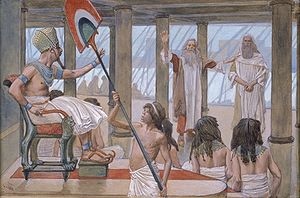
| Moses Speaks to Pharaoh (watercolor circa 1896-1902, James Tissot) |
Now by this time the Egyptian people have suffered much and they begged the Pharaoh to let the Israelites go. When Moses comes with the warning of the eighth plague, Pharaoh says: You say that you want to serve your G_d? I'll let the men go, as long as the women and children stay behind. No, says Moses, we must all go, men, women, children, cattle and herds. Pharaoh once again refuses.
The eighth plague that Moses warned of is the plague of locusts. It began on day 1 of the Hebrew month of Shevat. But before the plague came to be G_d told Moses that from that point on He would " harden the Pharaoh's heart" so that the Pharaoh would not give in and the remaining miracles (the final plagues and the parting of the Red Sea) would happen.
G_d has Moses stretch out his staff over Egypt and the wind picked up from the east. The wind continued until the next day, when it brought a swarm of locusts. The swarm was so thick that it cast a shadow over Egypt. What was left of Egyptian crops were consumed by the locusts, leaving no plant or tree standing. Again Moses was asked to remove the locusts with the promise of religious worship for the Israelites and this time G_d blew them into the Red Sea. And as promised by G_d the Pharaoh's harden heart said no.
In the ninth plague is darkness. G_d commanded Moses to stretch his hands toward the sky to bring darkness upon Egypt. It was so heavy that the Egyptians could feel it. This lasted for three days, during which time there was light in the homes of the Israelites. Moses is called by the Pharaoh and offered to let the Israelites leave, if only the darkness is removed from the land. However, he requires that the sheep and cattle stay. Moses refused, and went on to say that the Pharaoh would soon be offering to provide animals for sacrifice. This enraged the Pharaoh, who then threatened to execute Moses if he should again appear before the Pharaoh again. Moses replied that he would not.
This plague was an attack on the Egyptian sun god Ra. By introducing the plague of darkness, Moses attempted to demonstrate the clear power of G_d and the folly of worshiping Egyptian gods.
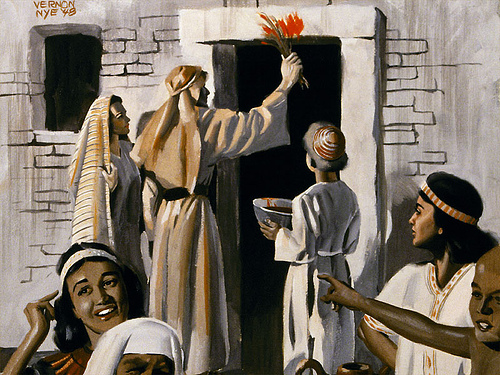
Before the final plague, the death of the firstborn, G_d has Moses tell the Israelites to mark lamb's blood on the doorposts of every door in which case the Lord will pass over them and they will not "suffer the destroyer to come into your house and smite you", thus sparing all the firstborns of the Israelites. This happened a the stroke of midnight of the 15th of the month of Nisan. This was the hardest blow to Egypt and the plague that not only took the Pharaoh's firstborn but it finally convinced to let the Israelites go.
As Moses quickly leads the Israelites out of Egypt, the Pharaoh changes his mind and send soldiers to retrieve his former slaves As the Egyptian army approaches the fleeing Israelites at the edge of the Red Se the final miracle happens: G_d parts the Red Sea, allowing Moses and his followers to cross safely, then closes the passage and drowns the Egyptians. According to the Jewish Bible, the Israelites- now numbering in the hundreds of thousands- then traveled through the Sinai desert for 40 tumultuous years before reaching their ancestral home of Canaan, later known as the Land of Israel.
The day before Passover is known as the Fast of the Firstborn, a minor fast commemorating the fact that the firstborn sons of Jewish households were not killed in Egypt during the final plague.
On the first night of Pesach there is a special family meal filled with a ritual to remind Jews of the significance of the holiday. This is what is called a seder, from the Hebrew root word for "order", because there is a specific set of information that must be discussed in a specific order. It is the same root from which the word "siddur" (prayer book) is derived.
Passover (Pesach) is divided into two parts:
The first two days and the last two days (the latter commemorating the parting of the Red Sea) are full fledged holidays. Holiday candles are lit at night and kiddush* and wonderful holiday meals are enjoyed on both nights and days. However, Jews don't go to work, drive, turn on or off electrical appliances ( some appliances now come with a Shabbat mode*) and write. But cooking and to carry outdoors*.
The middle four days are called chol hamoed, semi-festive "intermediate days", when most forms of work is allowed.
| Chametz |
What is probably the most significant part of Passover is the avoidance of chametz, leaven bread. This commemorates the unleavened bread that the Israelis ate when they left Egypt, because there was no time for their bread to rise. Jews don't keep any kind of chametz from midday the day before Passover to the end of the holiday. This also includes not having any kind of food or drink that contains leavened grain such as, cakes, breads, cookies, cereal, pasta, and most alcoholic drinks, beer, Scotch, etc. And almost all process food can be considered chametz, unless otherwise stated.
Ridding the home of chametz is an intensive process. It involves a full on spring-cleaning mission weeks before the holiday and climaxes with the search for chametz on the night before Passover and the burning of the chametz ceremony the morning before the holiday. Chametz that cannot be disposed of can be sold to a non-Jew for the duration of Passover.
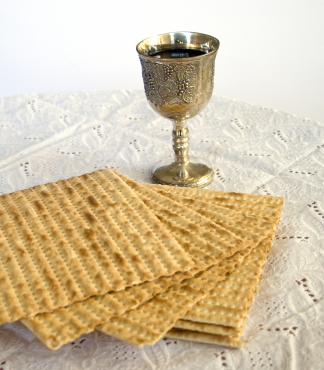
| Matzah and Kiddush Cup |
Instead of eating chametz, Jews eat matzah, a flat unleavened bread. It is a mitzvah* to partake in matzah on the two Seder nights and during the rest of the holiday it is optional.
The highlight of Pesach is the Seder, which is observed on the first two nights of the holiday. The Seder is a 15 step family-oriented tradition and ritual packed meal. They are:
- Kaddesh : Sanctification - A blessing over wine in honor of the holiday. The wine is drunk and the second cup is poured.
- Urechatz : Washing - A washing of the hands without a blessing in preparation for eating karpas.
- Karpas : Vegetable - Parsley dippedJewish people. The salt water represents the tears that they shed in slavery.
- Yachatz : Breaking - One of the three matzahs on the table is broken. Part is returned to the pile the other is set aside for afikomen.
- Maggid : The story - The retelling of the Exodus out of Egypt and the first Passover. This begins with the youngest child present asking the Four Questions also known as Mah Nishtanah ( Why is it different?)*, but if there are no children at the Seder then anyone can ask. The maggid is designed to satisfy the needs of four different types of people : the wise one, who wants to know the technical details; the wicked one, who excludes himself (and learns the penalty for doing this); the simple one, who needs to know the basics; and the one who is unable to ask, for he doesn't even know enough to know what he needs to know. At the end of the maggid a blessing is said over the second cup of wine and it is drunk.
- Rachtzah : Washing - Second washing of the hand, but with a blessing, in prepparation of the eating of the matzah.
- Motzi : Blessing over grain products - The ha-motzi blessing is a generic blessing for bread or grain products used as a meal, is recited over the matzah.
- Matzah : Blessing over Matzah - A specific matzah blessing is recited and a bit of matzah is eaten.
- Maror : Bitter Herbs - Blessing recited over a bitter vegetable, usually raw horseradish and it 's eaten. This symbolizes the bitterness of slavery.The maror is dipped in charoset, a mixture of apples, nuts, cinnamon and wine, which is symbolic of the mortar used by the Jews during slavery.
- Korekh : The Sandwich - Rabbi Hillel* was of the opinion that the maror should be eaten together between two pieces of matzah . In his honor, some maror is put on a small piece of matzah, with some charoset, and eaten.
- Shulchan Orekh : Dinner- The festive meal is eaten.Traditionally this begins with the charred egg on the Seder plate. Otherwise, with the exception of chamez,there is no particular requirement regarding what to eat at this meal. Some Jewish Families serve matzah ball soup, while others may serve turkey or beef brisket.
- Tzafun : The Afikomen - This is the piece of matzah that was set aside earlier and is now eaten as 'dessert', the last food of the meal. Different families have different customs when it comes to the afikomen. In some families the parents hide the piece of matzah and the children go in search of it and in other families, the children hide it and the parents go and look for the matzah. But mainly it is the children who do the searching because the adults want them to stay awake and attentive throughout the pre-meal proceedings, waiting for this part.
- Barekh - Grace After Meals - The third cup of wine is poured and the birkat ha-mazon (grace after meals) is recited. This is similar to the grace that would be said on any Shabbat. At the end, a blessing is said over the third cup of wine and it's drunk. The fourth cup is poured, including a cup set aside for the prophet Elijah, who is supposed to have herald the Messiah and is supposed to come on Pesach to do this. The door is opened for a while at this point for Elijah.
- Hallel : Praises - Several psalms are recited. And a last blessing is recited over the cup of the last wine and it is drunk.
- Nirtzah : Closing - A simple statement that the Seder has been completed, with a wish that next year, that the Jews may celebrate Pesach in Jerusalem. This is followed by various hymns and stories.
* kiddush - A blessing recited over a cup of wine
* Shabbat (Sabbath) mode - a feature in many modern home appliances, including refrigerators and ovens, which is intended to allow the appliance to be used ( subject to various constraints) by Shabbat-observant Jews on the Shabbat or and Jewish holidays. Observant Jews interpret the Jewish law forbidding them from doing creative work on the Shabbot, to include making a fire, preparing meals or even closing a switch or pressing a button.
* Carry outdoors : http://www.chabad.org/holidays/passover/pesach_cdo/aid/708532/jewish/Laws-of-Yom-Tov.htm
*Mitzvah - Refers to precepts and commandments as commanded by G_d. Any of the 613 commandments that Jews are obligated to observe. It can also refer to any Jewish religious obligation or more generally, any good deed.
* The Four Questions (Mah Nishtanah) :
1. Why is it on all other nights during the year we eat either leavened bread or matzah, but on this night we eat only matzah? We eat only matzah because our ancestors could not wait for their breads to rise when they were fleeing slavery in Egypt and so they were flat when they came out of the oven.
2. Why is it that on all other nights we eat all kinds of vegetable, but on this night we eat bitter herbs? We eat only Maror, a bitter herb, to remind us of the bitterness of slavery that our ancestors while in Egypt.
3. Why is it that on all other nights we do not dip [our food] even once, but on this night we dip them twice? The first dip, green vegetable in salt water, symbolizes the replacing of our tears with gratefulness and the second dip, maror in charoset, symbolizing the sweetening of our burden of bitterness and suffering.
4. Why is it that on all other nights we dine either sitting upright or reclining, but on this night we all recline? We recline at the Seder table because in ancient times, a person who reclined at a meal was a free person, while slaves and servants stood.
* Rabbi Hillel - A famous Jewish religious leader leader born around 110 B.C.E.in Babylon and died 10 CE. in Jerusalem. He is responsible for the Golden Rule. For more information about Hillel the Elder : http://www.jewishencyclopedia.com/articles/7698-hillel
Thursday, March 15, 2012
Ides of March
| Mort de Cesar, 1798 - Vincenzo Camuccini |
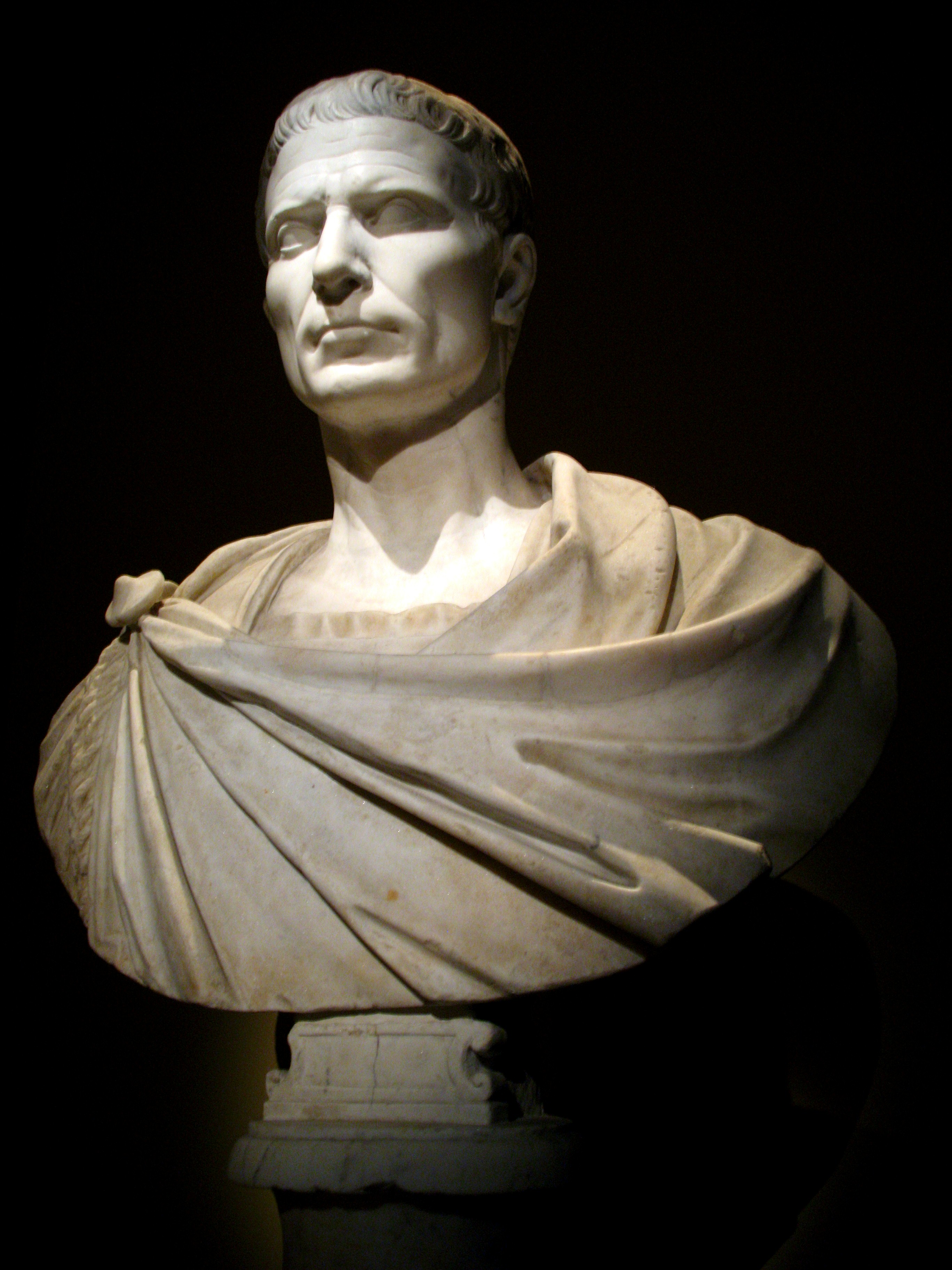
March 15 has come down through the annals of history as the Ides of March. Because it is on this day, in 44 B.C., that Julius Caesar met his death by being stabbed 23 times in the Roman Senate by a group of conspirators including, Marcus Junius Brutus and Gaius Cassius Longinus, along with a group of 60 co-conspirators.Mark Antony had only vaguely learned of the assassination plot the night before from a terrified Liberator and fearing the worse, went to head off Caesar. Fearing that Antony would get to Caesar and warn him of the plot, the assassins sent one of their own, Trebonius ( according to Plutarch it was Brutus Albinus) , to intercept Anthony as he was making his way to the portico of the Theater of Pompey, where the Roman Senate was to meet.
According to Greek historian, essayist, biographer and Middle Platonist, Plutarch as Caesar arrived at the Senate he was presented with a petition by Roman senator Tillius Cimber, to recall his exiled brother. The co-conspirators crowded around in support of Tillius Cimber. Both Plutarch and Roman historian, Suetonius, say that Caeser waved him away but that Cimber grabbed at Caesar and pulled down Caesar's tunic. Caesar then cried to him "Ista quidem vis est" (" Why, this is violence") . At the same time, Servillus Casca produced his dagger and made a glancing thrust at the neck of Caesar. But Caesar quickly turned around and caught Casca's arm. According to Plutarch, Caesar said to "Casca, furcifer quae agis" ("Casca, you villain, what are you doing?") Casca, scared, shouted in Greek " Help, brother!" Within moments, the entire group, including Brutus, was striking out at Caesar. Caesar made an attempt to get away from his murders, but he tripped and fell down the steps because he was blinded by his blood that was being spilled. As he laid defenseless at the bottom steps of the portico, his murders swooped down upon Caesar and continued to stab him to death. According to the ancient Roman historian, Eutropius, around 60 or more men took part in the murder of Julius Caesar. He was stabbed 23 times. According to the historian Suetonius, a physician determined that Caesar died from only one wound, the second one into his chest. Caesar's body laid on the Senate floor for three hours before other officials came and removed it.
Casear's last words are not known to be certain and have been a point of discussion for historians and scholars alike. Suetonius has reported that others have said Caesar's final words to be the Greek phrase "Kai su, teknon?" : "You too, my child?" in English or "Tu quoque, Brute, fili mi" in Latin. Caesar speaking Greek would not have appeared strange, for he is known to have spoken the language excellently. However, Suetonius says that Caesar did not speak. Plutarch also states that Caesar said nothing, he just merely pulled his toga over is head when he saw Brutus among the murderers. According to Plutarch, after the assassination, Brutus stepped forward as if to say something to his fellow senators, but they had already fled the portico. Brutus and his companions then marched to the Capitol while hollering out to their beloved city: "People of Rome, we are once again free!" They were met with deafening silence, for the Roman citizens had heard the rumor of Caesar's demise ad had locked themselves in their houses.
Caesar's body was cremated and on his cremation site the Temple of Caesar was built a few years later ( at the east side of the main square of the Roman Forum). Now, only its alter remains. A life-size wax figure of Julius Caesar was later erected in the forum displaying the 23 stab wounds. A crowd that had gathered at the statue started a fire that spread that damaged the forum and neighboring buildings. In the chaos that followed, Mark Antony, Octavian ( later Augustus Caesar) and others fought a series of five civil wars, which would lead to the end of the Roman Empire.
| Roman Empire - 44 B.C. |
Tuesday, November 22, 2011
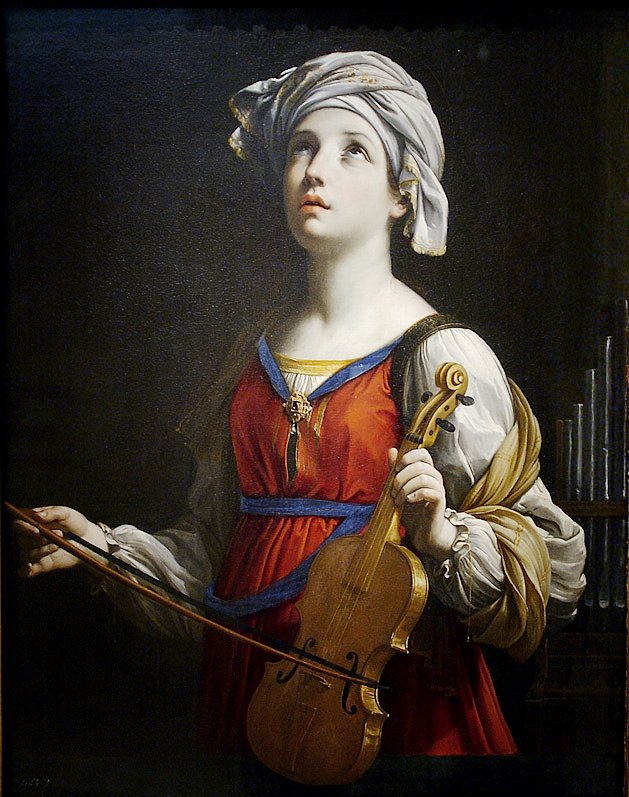
Saint Cecilia
| Saint Cecilia - Guido Reni, 1606 |
Saint Cecilia(Latin:Sancta Caecilia) is the patron saint of musicians,composers,instrument makers, music( especially Church music) and poets. The name Cecilia means blind and so, although it is not known for sure if she could see or not, she is also the Catholic patron saint of the blind. Saint Cecilia is the patron saint of music because as she was dying she sang to God. It is also written that when she was forced to marry Valerian, a pagan, she "sang in her heart to the Lord" as the musicians played. Her feast day is November 22 . She is one of seven women, excluding the Virgin Mary,commemorated by name in the Canon of the Mass.
It is believed that Saint Cecilia was born in the 2nd or 3rd century A.D. A religious romance telling the love story of Saint Cecilia and Valerian appeared in Greece in the 4th century A.D., and there is a biography of Saint Cecilia from the 5th century A.D. She is said to have been the daughter of a wealthy Roman family, a Christian from birth, who was promised in marriage to Valerian. Cecilia, however, had vowed her virginity to God and wore sackcloth, fasted and prayed in hopes of keeping this promise. Saint Cecilia told her husband of her wishes on their wedding night. She also told him that an angel watched over her to guard her purity. He wanted to see the angel, so Saint Cecilia sent him to Pope Urban Accounts on how and when Valerian saw the angle vary, but one states that Pope Urban baptized him and upon his return to Saint Cecilia, he saw her praying in her chamber and an angel by her with flaming wings, holding two crowns of lilies and roses, which he placed on their heads and then vanished. Another version says that Valerian's brother, Tibertitus, sees the crowns and is also converted.
After their conversion, the two brothers made it their mission to bury the martyrs that were daily being put to death by the prefect of the city, Turcius Almachius ( there was no prefect of that name). When the prefect heard of the brothers doings, he had them arrested and brought before the prefect, when Valerian and Tibertitus refused to sacrifice to the gods, they were executed by the sword. In the meantime, Saint Cecilia continued with making conversions of 400 people, who Pope Urban immediately baptize. She also prepared her home to become a church at her death.Then she was arrested and brought before the prefect.He ruled that she should die by suffocation in the baths. She was shut in for a day and a night and the fires were heaped up and made to glow and roar to their utmost, but Saint Cecilia did not perspire through the heat. Since she was still alive she was the ordered to be beheaded, but the executioner struck Saint Cecilia 3 times without severing her head and she would not die without receiving the Holy Communion. This left her mortally wounded and survived for 3 more days. In this time Saint Cecilia made more conversions and people came to her cell to soak up her blood with cloths and sponges. When she died the people by her cell knew she was destined to be a saint in Heaven.
| Martyrdom of Saint Cecilia, by Stefano Maderno, ca. 1599-1600 |
| Facade of Santa Cecilia, a 1775 project with a 12th century belltower |
Saturday, November 12, 2011
Edmund Fitgerald
This past Thursday marked the 36th anniversary of the Wreck of the Edmund Fitzgerald. The S.S Edmund Fitzgerald was an American freighter that made headlines after sinking in Lake Superior on November 10,1975, 17 miles north-northwest of Whitefish Point, Michigan with the entire crew of 29 men going down with her. The crew consisted of the captain,the first, second and third mates, five engineers,three oilers, a cook, a wiper ( the junior crew member of the ship's engine room), three watchman, two maintenance men,three deckhands, two porters, a cadet, three wheelsmen, and a steward. Most of the crew were from Wisconsin and Ohio, ranging in age from the 21 year old deckhand Mark Andrew Thomas to the 63 year old Captain Ernest M. McSorely, who was planning his retirement.
When launched on June 8,1958, she was the largest boat on the Great Lakes and the Edmund Fitzgerald suffered a series of mishaps during her launch: it took three attempts to break the champagne bottle used in her christening, which is bad luck in and of itself, but then she collided with a pier when she entered the water.The ship was nicknamed "Fitz", "Big Fitz" and the "Mighty Fitz. The Edmund Fitzgerald still remains the largest boat to ever sink in the Great Lakes.
For 17 year "Fitz" carried taconite ( an iron-bearing, very fine-grained ,tough rock) from mines near Duluth, Minnesota, to iron works in Detroit, Toledo and other ports. As a "workhorse" she set a seasonal haul records 6 different times, often beating her own record. Her size, record-breaking performance and "DJ captain" endeared her to bota watchers. Captain Peter Pulcer was known for piping music over the ship's intercomsystem while passing through the Dtroit and St. Clair rivers and entertaining spectators at Sault Locks with running commentary about the ship.
With McSorely at the helm that fateful day,the Edmund Fitzgerald embarked on her final journey from Superior, Wisconsin, on June 9,1975, to a steel mill near Detroit, Michigan. En route she joined another freighter ship the "SS Arthur M. Anderson". By the next day the two ships were caught up in a massive winter storm,with near hurricane force winds and 35 feet high waves. At about 7:10 pm the Edmund Fitzgerald suddenly sank in Canadian waters about 17 miles from Whitefish Bay, at a depth of 530 feet.Even though the ship had been having troubles earlier in her voyage no distress signal was ever made before she sank. None of the ship's crew bodies were ever recovered.
There have been many theories, books, studies and expeditions have studied the cause of the sinking, ranging from rogue waves, structural failure, being swamped with water entering through her cargo hatches or deck, damage to her topside to being shoaled (from what I can figure out, running up onto a sandbar) in a shallow part of Lake Superior. Investigations into the sinking have lead to changes in Great lakes shipping regulations and practices including mandatory survival suits, depth finders, positioning systems, increased freeboard ( the distance from the water level to the upper deck level) and more frequent inspections of vessels.
At the request of surviving family members of the crew, the 200 pound bronze bell of the Fitzgerald was recovered by the Great Lakes Shipwreck Historical Society on July 4,1995. This expedition was done by the National Geographic Society, the Canadian Navy, Sony Corporation and the Sault San Marie Tribe of the Chippewa Indians. The bell is now on display at the Great lakes Shipwreck Museum as a memorial to her lost crew. Personal note: I remember seeing a documentary about the recovery of Edmund Fitzgerald's bell. The ships bell that was brought up was replaced by another bell with the names of the crew members etched on it. The one thing that stuck with me the most is that a daughter of one of them saw a butterfly just as the replacement bell was being lowered, which is an odd thing because butterflies don't usually go that far out. Plus when the ships bell was coming to the water's surface the replacement bell broke from its rope and dropped into the water on its own.
Canadian singer-songwriter Gordon Lightfoot made it the subject of his 1976 hit ballad, "The Wreck of the Edmond Fitzgerald". Lightfoot considers this to be his best work. It originally appeared on his 1976 album Summertime Dream and was later released as a single.The song hit #1 in Lightfoot's native Canada on November 20, 1976, almost exactly 1a year after the sinking of the ship that inspired it. In America the song went to #2 on the U.S. Billboard Hot 100 chart for two weeks making it Lightfoot's second most successful single ( in terms of chart position) in that country. "The Wreck of the Edmund Fitzgerald" peaked at #40 on the U.K. Singles chart. So the 35th anniversary of the song is approaching.
THE WRECK OF THE EDMUND FITZGERALD
The legend lives on from the Chippewa on down
of the big lake they call "Gitche Gumee'.
The lake it is said never gives up her dead
When the skies of November turn gloomy.
With a load of iron ore weighing twenty-six thousand tons more
Than the Edmund Fitzgerald weigh empty,
That good ship and true was a boned to be chewed
When the "Gales of November" came early.
The ship was the pride of the American side
Coming back from some mill in Wisconsin.
As the big freighters go, it was bigger than most
with a crew and captain well seasoned,
Concluding some terms with a couple of steel firms
When they left fully loaded for Cleveland.
And later that night when the ship's bell rang
Could it be the north wind they'd been feelin'?
The wind in the wires made a tattle-tale sound
And a wave broke over the railing.
And ev'ry man knew as the captain did too
'twas the witch of November come stealin'.
The dawn came late and breakfast had to wait
When the Gales of November com slashin'.
When afternoon came it was freezin' rain
in the face of hurricane west wind.
When suppertime came the old cook came on deck sayin'
"Fellas, it's too rough t'feed ya."
At seven p.m. a main hatchway caved in; he said
"Fellas it's been good o know ya!"
The captian wired he had water comin' in
and the good ship and crew was in peril.
And later that night when he lights went outta sight
came the wreck of the Edmund Fitzgerald.
Does any one know where the love of God goes
when the waves turn the minutes to hours?
The searchers all say they'd have made Whitefish Bay
if they put up fifteen more miles behind 'er.
They might have split up or they might have capsized
they may have broke deep and took water.
And all that remains is the faces and the names
of the wives and the sons and the daughters.
Lake Huron rolls Superior sings
in the room of her ice-wter mansion.
Old Michigan streams like a young man's dream
the islands and bays are for sportsmen.
And farther below Lake Onterio
takes in what lake Erie can send her.
And the iron boats go as the mariners all know
with the Gales of November remebered.
In a musty old hall in Detroit they prayed
in the "Maritime Sailor's Cathedral".
The church bell chimed 'til it rang twenty-nine times
for each man on the Edmund Fitzgerald".
The legend lives on from the Chippewa on down
of the big lake they call "Gitche Gumme"
"Superior" they said "never gives up her dead
when the Gales of November come early!"
Subscribe to:
Posts (Atom)